
MBTI (Myers–Briggs Type Indicator)
 Psychological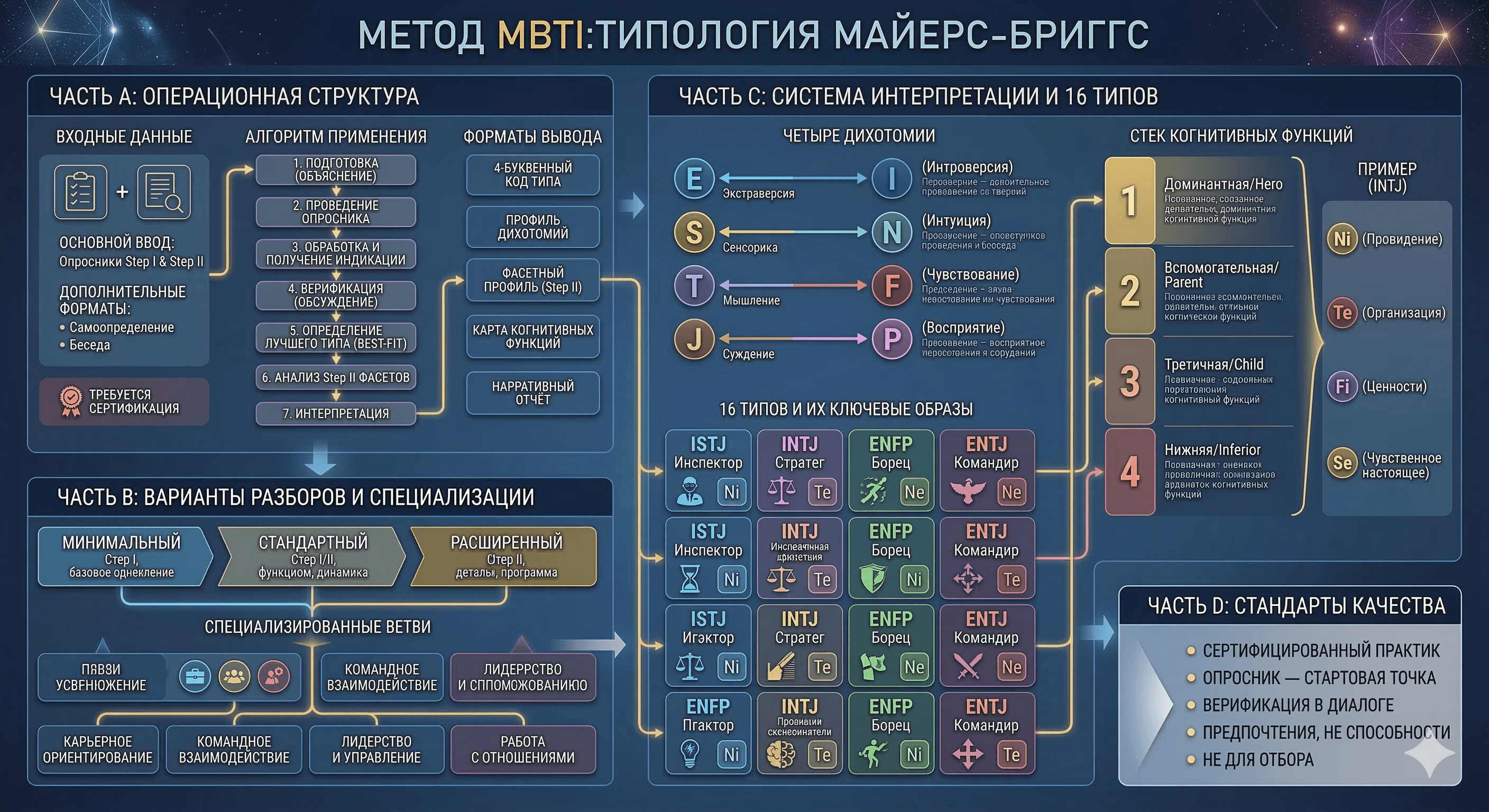
ON THE SPECIFICS OF THE METHOD
MBTI is one of the most widely used psychological typologies in the world. It is based on C.G. Jung's theory of psychological types, systematized and adapted by Isabel Myers and Katharine Briggs into a questionnaire format. It occupies an intermediate position: between academic psychology (Big Five) and symbolic systems. It has its own professional community, application standards, and an active critical discourse.
The language of MBTI is psychological typology: preferences, not traits; type, not profile.
PART A: WORKING ALGORITHM
Input Data
Primary format:
- MBTI Step I questionnaire (93 items) — determines the 4-letter type; standard instrument; requires certification for official application
- MBTI Step II (144 items) — determines type + 20 facets (5 per dichotomy); extended diagnostics
- MBTI Step III — narrative instrument, applied in coaching/developmental programs
Additional formats:
- Guided self-selection — the practitioner guides the client through type descriptions; applied in certified practice
- Verification interview — discussion of the appropriate type after the instrument
Important condition:
- Official MBTI requires a certified practitioner (MBTI Certification Program from The Myers-Briggs Company)
- Numerous "unofficial tests" online are not validated; results are unreliable
- The questionnaire result is a hypothesis that must be verified in conversation
Application Algorithm
Step 1. Client preparation: explaining that MBTI measures preferences, not abilities; there are no "bad" types; the questionnaire is not "right/wrong."
Step 2. Administering the questionnaire under standard conditions.
Step 3. Processing: scoring on four dichotomies → obtaining the "indication" (reported type).
Step 4. Discussing the result with the client (verification):
- The practitioner presents a description of the "indicated type"
- The client evaluates how well the description resonates
- If necessary, adjacent types are considered
Step 5. Determining the "verified type" (best-fit type) — the one the client identifies with.
Step 6. For Step II: facet analysis — which specific aspects of each dichotomy are expressed.
Step 7. Interpretation: type characteristics + cognitive functions + type dynamics + application to the client's inquiry.
Output Formats
- 4-letter type code (e.g., INTJ, ESFP) + its detailed description
- Dichotomy profile (Step I): position on each of the four scales + strength of preference
- Facet profile (Step II): 20 subscales within the four dichotomies
- Cognitive function map (for advanced interpretation): dominant → auxiliary → tertiary → inferior functions
- Narrative report: full type description + application to a specific context (career, communication, leadership, relationships)
PART B: ANALYSIS VARIANTS
Minimal Reading
Instrument: MBTI Step I.
Content: determination of the 4-letter type + verification + basic type characteristics.
Format: 60-minute consultation; written type report.
Standard Reading
Instrument: MBTI Step I or Step II.
Content:
- Verified type + detailed description
- Cognitive functions of the type: stack (dominant — auxiliary — tertiary — inferior)
- Type dynamics: how functions work together
- Application to the inquiry: communication, decision-making, stress, development
Format: 90 minutes; full written report.
Extended Reading
Additional content:
- Step II facets: detailed breakdown within each dichotomy
- Type dynamics in a specific context (work, family, creativity)
- Type comparison in a couple or team: interaction patterns
- Type-based development program: growth zones for inferior and tertiary functions
Format: 2 hours + detailed written report.
Specialized Branches
1. Career Guidance Matching type to professional environments. Identifying roles compatible with cognitive preferences. Applied in career transition coaching.
2. Team Building Team type map: team strengths and blind spots, role distribution, zones of typical conflict.
3. Leadership and Management Leadership style by type + adaptation to different types of subordinates / colleagues.
4. Relationship Work Interaction patterns between two types: compatibility, typical tensions, communication strategies.
PART C: INTERPRETATION SYSTEM
The Four Dichotomies
| Dichotomy | Pole 1 | Pole 2 |
|---|---|---|
| E / I — energy source | Extraversion: orientation toward the external world, people, actions | Introversion: orientation toward the internal world, ideas, reflection |
| S / N — information gathering | Sensing: concrete, factual, present | Intuition: patterns, meanings, possibilities, future |
| T / F — decision-making | Thinking: logic, objective criteria, principles | Feeling: values, impact on people, harmony |
| J / P — orientation to the external world | Judging: structure, planning, closure | Perceiving: flexibility, spontaneity, openness |
16 Types and Their Key Images
| Type | Traditional Image | Dominant Function |
|---|---|---|
| ISTJ | Inspector / Guardian | Si (Introverted Sensing) |
| ISFJ | Protector / Guardian | Si |
| INFJ | Counselor / Visionary | Ni (Introverted Intuition) |
| INTJ | Strategist / Architect | Ni |
| ISTP | Virtuoso / Craftsman | Ti (Introverted Thinking) |
| ISFP | Artist / Adventurer | Fi (Introverted Feeling) |
| INFP | Mediator / Idealist | Fi |
| INTP | Scientist / Thinker | Ti |
| ESTP | Dealer / Entrepreneur | Se (Extraverted Sensing) |
| ESFP | Entertainer / Performer | Se |
| ENFP | Champion / Campaigner | Ne (Extraverted Intuition) |
| ENTP | Debater / Inventor | Ne |
| ESTJ | Administrator / Director | Te (Extraverted Thinking) |
| ESFJ | Consul / Nurturer | Fe (Extraverted Feeling) |
| ENFJ | Coach / Teacher | Fe |
| ENTJ | Commander / Marshal | Te |
Cognitive Function Stack
Each type has a hierarchy of 4 functions (+ 4 "shadow" functions):
| Position | Name | Characteristics |
|---|---|---|
| 1 (Dominant) | Hero | The strongest and most natural function; source of power |
| 2 (Auxiliary) | Parent | Supports the dominant; developed by adulthood |
| 3 (Tertiary) | Child | Less developed; can be a source of naive or playful behavior |
| 4 (Inferior) | Inferior | The weakest; emerges under stress; zone of growth and vulnerability |
Example (INTJ):
-
- Ni (Vision — inner picture of the future)
-
- Te (Organizing external reality through systems)
-
- Fi (Personal values — less visible to others)
-
- Se (Sensory present — vulnerability zone; under stress, INTJ may hyperfocus on details and sensations)
Logic and Interpretation Rules
Preference, not ability. E/I is not "how much one socializes" but "where one draws energy." An introvert can be an excellent speaker; they simply become fatigued from social interactions rather than avoiding them.
Verified type takes precedence over indicated type. The questionnaire result is a starting hypothesis. The final type is determined in dialogue with the client.
Types, not scores. MBTI is not a continuum. A person is not "more E than another E"; both are E, simply expressed differently (Step II facets describe this).
Development through functions. Type maturity means mastering the auxiliary function, then working with the tertiary. The inferior function remains a zone of growth throughout life.
Typical Patterns
1. INTJ Under Stress (Si / Se Hypertrophy) When overloaded, the INTJ (Ni-dominant) may "fall into" the inferior Se: obsessive attention to bodily sensations, appearance, details. Recovery — return to Ni-strategy through withdrawal from stimuli.
2. ENFJ and Fe Overload ENFJ lives through the satisfaction of others. With chronic neglect of inferior Ti (logical analysis) — accumulation of unresolved contradictions, emotional burnout.
3. INTP and Procrastination (Inferior Fe / Si) INTP (Ti-dominant) has difficulty translating conceptual decisions into concrete actions. Inferior Si makes routine difficult; weak Fe — public commitments as a motivator.
4. ESTJ and Dealing with Ambiguity Dominant Te requires clear criteria and systems. Under high ambiguity (no data — no decision), ESTJ often shifts to hypercontrol. Working with inferior Fi is the key.
5. Similar Types with Different Profiles INFJ and INFP are often confused — both configurations are introverted, Intuitive, Feeling. The difference: INFJ (Ni-Fe) — strategic vision through imagery + people orientation. INFP (Fi-Ne) — personal values as a compass + generation of possibilities.
PART D: QUALITY STANDARDS
Signs of Correct Application
- The practitioner is certified (MBTI Certification) or works under the supervision of a certified specialist
- The questionnaire is only a starting point; the result is verified in dialogue
- The practitioner explains to the client: these are preferences, not abilities; there are no "better" types
- The result is not used as a basis for selection or discrimination
- When working with types in a team, confidentiality is maintained
Typical Practitioner Errors
-
Label without verification. "Your test showed INFJ — you are INFJ." Without a verification interview, the type is not determined.
-
Conflation with Big Five. An MBTI score is not comparable to a Big Five E/I T-score. Different constructs, different instruments.
-
Conflation with Socionics. MBTI types and Socionics TIMs are different models. Direct translation (INTJ → ILI) is incorrect: different theoretical foundations, different function sets.
-
Use for selection. MBTI is not validated for personnel selection; its use in HR decisions creates legal and ethical risks.
-
Homemade internet tests. Numerous "MBTI tests" are not official instruments. Their results are unreliable.
Typical Interpretation Errors
-
Type as a verdict. "I'm INTP — I can't work in a team." MBTI describes preferences, not fixed behavior. Any type can develop any skills.
-
Ignoring function dynamics. Reducing a type to "4 letters" without analyzing the function stack loses most of the substantive information.
-
Overestimating preference strength. The "preference strength" scale in MBTI Step I is not analogous to Big Five T-scores. A weak preference for E does not mean "almost I."
-
Type without context. An ENFP-entrepreneur and an ENFP-therapist are very different people. Type is a foundation, not a complete description.
Competence Boundaries
- Not a clinical diagnostic tool. MBTI does not diagnose personality disorders, depression, or anxiety
- Not intended for personnel selection without additional validation for a specific criterion
- Does not predict professional success as a standalone instrument
- Does not replace psychotherapy: awareness of type is not transformation
- In psychological crises, the practitioner refers to a psychologist or psychiatrist
PART E: THEORETICAL BASE
Primary Sources
- C.G. Jung, "Psychological Types" (Psychologische Typen, 1921) — the original type theory on which MBTI is built; Jung described extraversion/introversion and four functions (thinking, feeling, sensation, intuition)
- Katharine Cook Briggs — began researching types based on Jung in the 1920s; developed the first classification instrument
- Isabel Briggs Myers — daughter of Katharine Briggs; developed the questionnaire (1940s–1975); author of "Gifts Differing" (1980) — the key text of the tradition
- Mary H. McCaulley — co-founder of the Center for Applications of Psychological Type (CAPT)
Schools and Authorities
- The Myers-Briggs Company (formerly CPP) — official publisher; controls certification
- Association for Psychological Type International (APTi) — professional community; conferences, publications
- Center for Applications of Psychological Type (CAPT) — research and training
- John Beebe — Jungian analyst; developed the 8-function model (shadow functions); significant influence on the modern MBTI practitioner community
- Linda Berens — temperament model + MBTI; pragmatic integration
Current State
- One of the most widely used psychological instruments in the world (~2 million assessments per year in the corporate sector)
- Active criticism from academic psychology: low test-retest reliability, debates about construct validity, correlation with Big Five
- Active practitioner community; regular international conferences (APTi)
- Development of cognitive function theory as an independent direction (especially in online communities)
- Emergence of MBTI-based systems: Enneagram + MBTI, MBTI + temperaments (Keirsey)
PART F: PRACTICAL FORMATS
Session / Consultation Formats
Individual Consultation:
- Duration: 60–90 minutes
- Format: in-person or remote
- Includes: questionnaire + result analysis + verification + application to the inquiry
- Report: full written type analysis
Team Workshop:
- Duration: half-day or full day
- All participants take the MBTI; a team type map is constructed
- Working with interaction patterns, role distribution
Coaching Series:
- 4–8 sessions; each session — deepening into a specific aspect of type
- Longitudinal work with cognitive functions
Frequent User Questions
- What is my type?
- Can my type change over time?
- Why does the test give different results on different days?
- Which type is most compatible with mine?
- Am I INFJ or INFP?
- How does my type affect my work style?
- Is there a "bad" type for leadership?
- How does MBTI differ from Socionics?
- How does MBTI differ from Big Five?
- What are cognitive functions and why are they important?
Descriptive Fragment Examples
Fragment 1 — type verification: "The questionnaire indicated INTJ. Let me describe this type: orientation toward creating systemic long-term strategies; high independence of judgment; tendency to work in solitude; often — high standards for oneself and others. How well does this resonate with your experience? Particularly regarding independence in decision-making and an inner vision of the future?"
Fragment 2 — cognitive functions: "Your verified type is ENFJ. This means your dominant function is Extraverted Feeling (Fe): you instantly read the emotional state of a group and strive for harmony. Auxiliary Ni allows you to see deep patterns beneath surface phenomena. The vulnerability zone is inferior Thinking (Ti): under stress, you may excessively resort to logical explanations as an attempt to control the situation, which comes across as inflexible."
Fragment 3 — application to inquiry: "You say it is difficult for you to defend your position in conflicts. This is a typical pattern for the F-preference: making decisions through values and harmony creates discomfort in direct confrontation. This is not weakness — it is a style. The task is not to become a T-type, but to teach your Fe-style to hold a position without losing your orientation toward relationships."
PART G: PLATFORM COMPATIBILITY
Recommended Combinations
Big Five (#3) Different levels of description. Big Five is a psychometric profile (how much?); MBTI is a typological description (what style?). Can be applied in parallel: Big Five for prediction, MBTI for understanding style and preferences. Condition: do not mix interpretive languages.
Jungian Archetypes (#11) Common origin — Jung's theory. Archetypes describe the content of the psyche (images, narratives); MBTI — its structure (how information is processed). Parallel application: MBTI shows "how one thinks," archetypes — "what one experiences." When working with an analytical psychologist — an organic connection.
Enneagram (#9) Different axes of description: MBTI — cognitive style, Enneagram — motivational core. Widely applied together in coaching practice. Condition: clear separation of what each instrument describes.
Incompatible Combinations
- Direct translation to Socionics (#8): "INTJ = ILI" — incorrect. Different theoretical foundations, different function models; confusion from mixing is widespread and harmful
- Mixing MBTI preferences with Big Five traits in one interpretive narrative: different ontologies (preference vs. trait)
What the Method Does Not Replace
- Clinical psychodiagnostics — MBTI does not diagnose personality disorders
- Psychotherapy — working with type and its functions ≠ a psychotherapeutic process
- Professional selection without additional validation — MBTI is not intended as the sole selection instrument
- Academic personality psychology (Big Five) in contexts requiring psychometric rigor
PART H: SOURCES
Canonical Texts of the Tradition
- Jung, Carl G. (1921). Psychologische Typen. Rascher Verlag. — The primary source of psychological function typology.
- Myers, Isabel Briggs & Briggs, Katharine Cook (1962). Myers-Briggs Type Indicator Manual. Consulting Psychologists Press. — The original instrument manual.
- Myers, Isabel Briggs & Myers, Peter B. (1980). Gifts Differing: Understanding Personality Type. Davies-Black. — The foundational exposition of MBTI theory for a broad audience.
- Myers, Isabel Briggs, McCaulley, Mary H. et al. (1998). MBTI Manual: A Guide to the Development and Use of the Myers-Briggs Type Indicator. 3rd ed. CPP.
- Quenk, Naomi L. (2002). Was That Really Me? How Everyday Stress Brings Out Our Hidden Personality. Davies-Black. — Theory of the inferior function.
Research and Critical Works
- Pittenger, David J. (1993). Measuring the MBTI… and coming up short. Journal of Career Planning and Employment, 54(1), 48–52. — Critical analysis of psychometric properties.
- McCrae, Robert R. & Costa, Paul T. Jr. (1989). Reinterpreting the Myers-Briggs Type Indicator from the perspective of the Five-Factor Model. Journal of Personality, 57(1), 17–40.
- Boyle, Gregory J. (1995). Myers-Briggs Type Indicator (MBTI): Some psychometric limitations. Australian Psychologist, 30(1), 71–74.
- Furnham, Adrian (1996). The big five versus the big four: the relationship between the Myers-Briggs Type Indicator (MBTI) and NEO-PI five factor model of personality. Personality and Individual Differences, 21(2), 303–307.
Reference and Educational Publications
- Nardi, Dario (2011). Neuroscience of Personality: Brain Savvy Insights for All Types of People. Radiance House. — Neurophysiological correlates of types.
- Thomson, Lenore (1998). Personality Type: An Owner's Manual. Shambhala. — Jungian interpretation of cognitive functions.
- Berens, Linda V. & Nardi, Dario (2004). Understanding Yourself and Others: An Introduction to the Personality Type Code. Telos Publications.
- Haas, Leona & Hunziker, Mark (2006). Building Blocks of Personality Type. Telos Publications. — Systematics of cognitive functions.
- Kroeger, Otto & Thuesen, Janet M. (1988). Type Talk: The 16 Personality Types That Determine How We Live, Love, and Work. Dell Publishing.
- Tieger, Paul D. & Barron-Tieger, Barbara (2001). Do What You Are. 3rd ed. Little, Brown. — Application of MBTI in career counseling.
Deep Method #4 — MBTI (Myers-Briggs Type Indicator) v1.0 — Errarium Project. Parts A–C — language of psychological typology. Parts D–G — neutral analytical language. Official application of MBTI requires certification from The Myers-Briggs Company.
Method Info
#4MBTI (Myers–Briggs Type Indicator)
Data D0+D3
Causality C1
Time T3
Result F1, F2, F4