
Numerology: Pythagorean School
 Numerological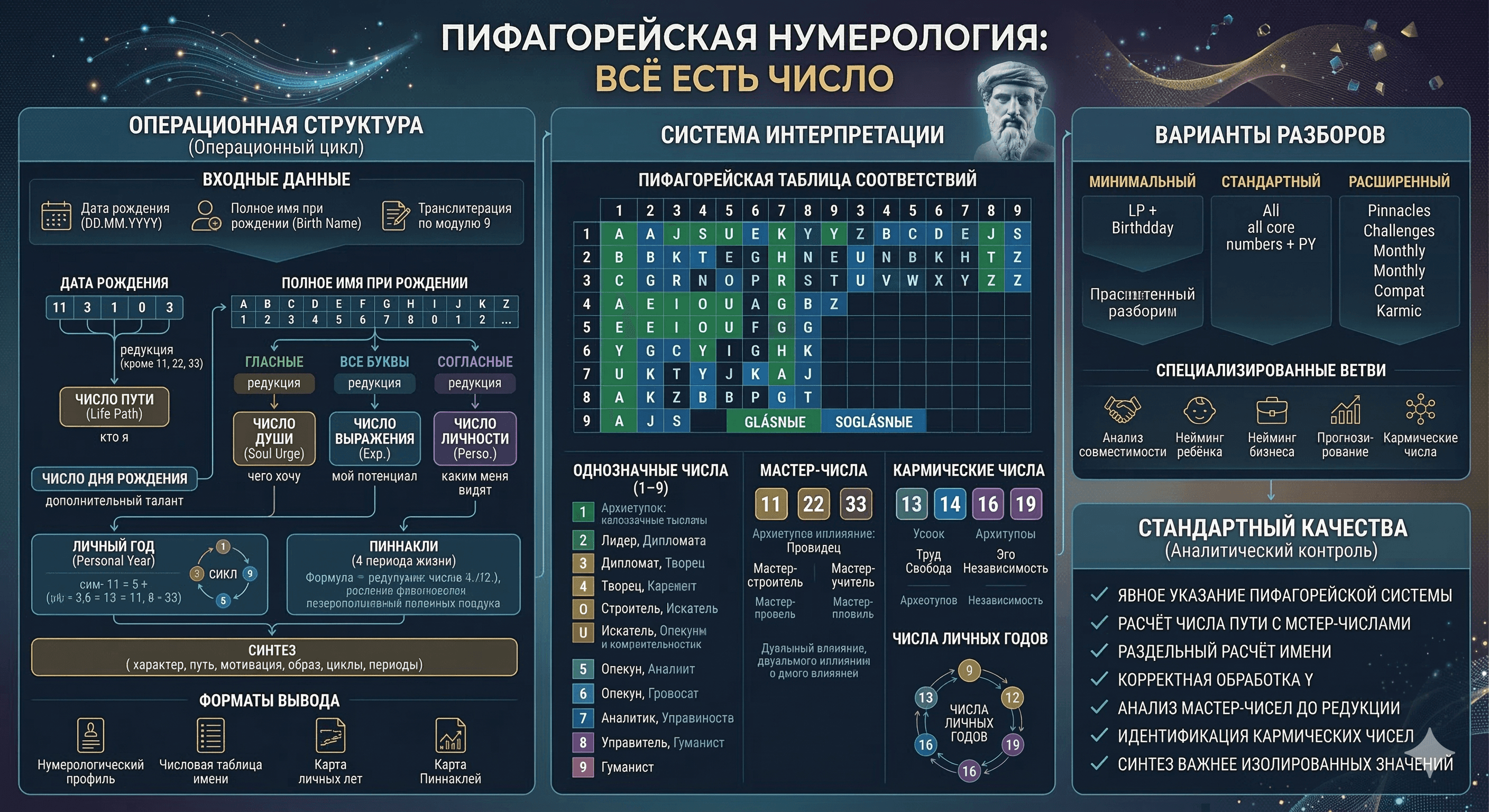
ON THE SPECIFICS OF THE METHOD
Pythagorean Numerology is a Western numerical system based on the principle "all is number" (πάντα ἀριθμός ἐστίν), attributed to Pythagoras of Samos (6th century BCE). Unlike Chaldean Numerology, which works with the vibrational correspondence of sound and number, the Pythagorean school uses a simple alphabetical correspondence: each letter receives a numerical value according to its ordinal position in the alphabet (A=1, B=2, C=3... and cyclically modulo 9). This makes the system maximally transparent and reproducible — any calculation can be verified.
The central instrument is the reduction of multi-digit numbers to single digits (1–9) through successive addition of digits. The exception is master numbers (11, 22, 33), which are not reduced and carry special interpretive weight. Two primary inputs: the date of birth (an unchangeable parameter) and the full name at birth (a changeable parameter). From the date of birth, the Life Path Number is calculated — the central characteristic of destiny. From the name, the Expression Number, Soul Urge Number, and Personality Number are extracted — three layers of the numerical portrait.
Temporal dynamics are realized through the system of Personal Years, Personal Months, and Pinnacles — four long-term life periods, each with its own numerical theme. This gives the method not only a diagnostic but also a predictive function: numbers describe not only "who I am" but also "what period is this."
PART A: WORKING ALGORITHM
Input Data
Required:
- Date of birth: day, month, year (accuracy to the day; time is not required)
- Full name at birth — in the spelling that is officially recorded (birth certificate)
Additional (extended reading):
- Variants of the name in use (diminutive, professional pseudonym, married name)
- Names of partner / children — for compatibility analysis
- Business or brand name — for naming consultation
- Date of a significant event — for analysis of the numerical characteristics of the day
Name requirements:
- The name is written in Latin letters; for non-Latin alphabets — transliteration according to the standard rules of the school
- Calculation is based on the birth name, not the currently used name
- Spelling is critical: one added or changed letter alters the numbers
- The practitioner must verify the exact spelling before calculation
Application Algorithm
Step 1. Record the full date of birth in numerical format (day, month, year).
Step 2. Calculate the Life Path Number:
- Add all digits of the date of birth → reduce to a single digit
- Example: 14.03.1987 → 1+4+0+3+1+9+8+7 = 33 → master number, not reduced
- Example: 25.11.1990 → 2+5+1+1+1+9+9+0 = 28 → 2+8 = 10 → 1+0 = 1
- Important: if an intermediate sum yields 11, 22, or 33 — stop reduction
Step 3. Write the full name at birth in Latin letters and assign numerical values according to the Pythagorean table (see Part C).
Step 4. Calculate the Expression Number (Destiny Number):
- Add the numerical values of all letters of the full name → reduce
- This is the overall potential given through the name; talents and abilities
Step 5. Calculate the Soul Urge Number (Heart's Desire Number):
- Add the numerical values of only the vowel letters of the name → reduce
- This is the inner motivation, hidden desires, deep needs
Step 6. Calculate the Personality Number:
- Add the numerical values of only the consonant letters of the name → reduce
- This is the outer image, how the person is perceived by others
Step 7. Calculate the Birthday Number:
- The day of birth (day only, without month and year) → reduce to a single digit
- Example: 14 → 1+4 = 5
- This is an additional accent on character, a special talent
Step 8. Calculate the Personal Year:
- Sum of birthday + birth month + current calendar year → reduce
- Determines the numerical theme of the current year for the given person
Step 9. Construct the Pinnacles — four long-term periods:
- 1st Pinnacle: sum of month and day of birth; lasts until 36 minus Life Path Number
- 2nd Pinnacle: sum of day and year of birth; lasts 9 years
- 3rd Pinnacle: sum of the 1st and 2nd Pinnacles; lasts 9 years
- 4th Pinnacle: sum of month and year of birth; lasts to the end of life
Step 10. Synthesis of interpretation: Life Path Number (who I am) + Expression Number (my potential) + Soul Urge Number (what I want) + Personality Number (how I am seen) + current Personal Year + current Pinnacle.
Pythagorean Numerology Algorithm:

  DATE OF BIRTH                      FULL NAME AT BIRTH
       |                                     |
       v                                     v
  +----------------+               +-------------------------+
  | Sum of all     |               | Assign numerical values |
  | digits of date |               | by table                |
  | -> reduce      |               | A=1, B=2 ... I=9 ...   |
  +-------+--------+               +------------+------------+
          |                                     |
          v                          +----------+----------+
  +----------------+                 |          |          |
  | LIFE PATH      |            VOWELS     ALL LETTERS  CONSONANTS
  | NUMBER         |                 |          |          |
  | "who I am"     |                 v          v          v
  +-------+--------+         +----------+ +--------+ +----------+
          |                  | SOUL     | | EXPRES-| | PERSONA- |
          |                  | URGE     | | SION   | | LITY     |
          |                  | NUMBER   | | NUMBER | | NUMBER   |
          |                  | "what I  | | "my    | | "how I   |
          |                  | want"    | | poten- | | am seen" |
          |                  +----+-----+ | tial"  | +----+-----+
          |                       |       +---+----+      |
          |                       |           |           |
          +-----------+-----------+-----------+-----------+
                      v
          +---------------------+
          | BIRTHDAY NUMBER     |---- additional talent
          +---------+-----------+
                    v
          +---------------------+     +------------------+
          | PERSONAL YEAR       |     | PINNACLES        |
          | theme of current    |     | (4 life periods) |
          | year                |     | long-term        |
          +---------+-----------+     | numerical themes |
                    |                 +--------+---------+
                    +----------+-------------+
                               v
                    +------------------+
                    | SYNTHESIS:       |
                    | character, path, |
                    | motivation,      |
                    | image, cycles,   |
                    | periods          |
                    +------------------+
Output Formats
- Numerological profile: structured text broken down by numbers — Life Path Number, Expression Number, Soul Urge Number, Personality Number, Birthday Number
- Name number table: letter → numerical value → vowel/consonant → subtotals → total; appended to the written reading
- Personal Year map: table of 9-year cycles with current and upcoming years
- Pinnacle map: chronological scale of four long-term periods with numbers and dates
- Name recommendations (if the inquiry is relevant): variants with calculations and rationale
- Oral consultation: accompanies written material; allows for clarification and personalization
PART B: ANALYSIS VARIANTS
Minimal Reading
Input data: date of birth only.
Content: Life Path Number → basic characteristics → key themes and challenges → Birthday Number → additional accent.
What is not included: name analysis, Personal Years, Pinnacles, compatibility.
Format: oral or short written summary; 20–30 minutes.
Application: first introduction to the system, quick orientation for the client.
Standard Reading
Input data: full name at birth + date of birth.
Content:
- Life Path Number + characteristics
- Expression Number + talents and potential
- Soul Urge Number + deep motivation
- Personality Number + outer image
- Birthday Number + special talent
- Relationship of all five numbers: harmony, tension, dominant themes
- Current Personal Year + its theme
Format: written reading + oral session; 60–90 minutes.
Extended Reading
Input data: name at birth + used variants + date of birth; if needed — partner's data, business name.
Additional content:
- Full Pinnacle map with dates and description of each period
- Challenge map (Challenges) — four challenge numbers, calculated through differences
- Personal Months of the current year
- Comparative analysis of birth name and currently used name
- Compatibility: numbers of two people by Life Path, Expression, and Soul Urge Numbers
- Karmic numbers (13, 14, 16, 19) — if present in calculations
Format: detailed written report + extended session; 90–120 minutes.
Specialized Branches
1. Compatibility Analysis Comparing Life Path, Expression, and Soul Urge Numbers of two people. Determining which numerical combinations create harmony and which create tension. Applied in romantic relationships, business partnerships, family constellations.
2. Naming (Name for a Child) Selecting a name with target Expression, Soul Urge, and Personality Numbers. Considering the child's Life Path Number (from the date of birth) and the parents' numbers. Result: list of name options with calculations.
3. Business and Brand Naming Calculating the Expression Number of a name → correspondence with the target market and the owner's intention. Comparative analysis of brand name spelling variants.
4. Cycle-Based Forecasting Detailed analysis of the sequence of Personal Years (9-year cycles), Pinnacles, and Challenges. Constructing a chronological life map with the numerical themes of each period.
5. Karmic Number Analysis In-depth work with karmic numbers (13, 14, 16, 19) if they appear in intermediate calculations before reduction. Each carries a specific karmic lesson.
PART C: INTERPRETATION SYSTEM
Pythagorean Correspondence Table
| Number | Letters (Latin) |
|---|---|
| 1 | A, J, S |
| 2 | B, K, T |
| 3 | C, L, U |
| 4 | D, M, V |
| 5 | E, N, W |
| 6 | F, O, X |
| 7 | G, P, Y |
| 8 | H, Q, Z |
| 9 | I, R |
Principle: sequential assignment by alphabetical order, cycle 1–9. A=1, B=2, ... I=9, J=1, K=2, ... R=9, S=1, etc. All 9 digits are used (unlike the Chaldean system, where 9 is not assigned to letters).
Vowels and consonants:
- Vowels: A, E, I, O, U — used for calculating the Soul Urge Number
- Consonants: all other letters — used for calculating the Personality Number
- Special case: the letter Y is treated as a vowel when it functions as a vowel sound (e.g., in the names Yves, Lydia, Mary)
Meanings of Single-Digit Numbers (1–9)
| Number | Archetype | Key Themes |
|---|---|---|
| 1 | Leader | Beginning, initiative, independence, willpower, originality, need to be first |
| 2 | Diplomat | Partnership, sensitivity, cooperation, balance, patience, intuition |
| 3 | Creator | Self-expression, communication, joy, creativity, optimism, scatteredness |
| 4 | Builder | Order, labor, discipline, reliability, practicality, limitations |
| 5 | Seeker | Freedom, change, adventure, adaptability, instability, experience through senses |
| 6 | Guardian | Responsibility, harmony, family, care, service, aesthetics |
| 7 | Analyst | Wisdom, analysis, spiritual search, solitude, depth, skepticism |
| 8 | Governor | Power, realization, ambition, material success, management, cyclical rises and falls |
| 9 | Humanitarian | Completion, service to the world, compassion, universal love, letting go, wisdom of experience |
Master Numbers
| Number | Archetype | Key Themes |
|---|---|---|
| 11 | Visionary | High intuition, inspiration, spiritual leadership, nervous tension, sensitivity. The potential of 11 is realized through service; without this — it reduces to the theme of 2 with additional inner conflict |
| 22 | Master Builder | Ability to realize large-scale projects, combination of vision and practicality, enormous potential with absolute discipline. Without discipline — theme of 4 with a feeling of unfulfillment |
| 33 | Master Teacher | The highest form of service, unconditional love, teaching by example. Extremely rare. Without realization — theme of 6 with excessive sense of responsibility |
Note: master numbers are not reduced. During calculation, if an intermediate sum yields 11, 22, or 33 — reduction stops. The practitioner must analyze both the master number and its reduced basis (11→2, 22→4, 33→6).
Karmic Numbers
| Number | Karmic Lesson |
|---|---|
| 13 | Lesson of labor: transformation through discipline and perseverance; laziness or attempts to take shortcuts lead to repetition of the cycle |
| 14 | Lesson of freedom: abuse of freedom in the past; the need to find balance between freedom and responsibility |
| 16 | Lesson of ego: destruction of the false self; crisis as an instrument of spiritual awakening; pride as the central theme |
| 19 | Lesson of independence: abuse of power in the past; the need to learn to accept help and consider others |
Karmic numbers manifest if they appear as an intermediate result (before final reduction) when calculating the Life Path Number, Expression Number, or Soul Urge Number.
Personal Year Numbers
| Personal Year | Period Theme |
|---|---|
| 1 | New beginning, sowing, initiative |
| 2 | Patience, cooperation, waiting |
| 3 | Creativity, communication, expansion |
| 4 | Labor, foundation, discipline |
| 5 | Change, freedom, surprises |
| 6 | Responsibility, home, family |
| 7 | Solitude, analysis, spiritual work |
| 8 | Harvest, power, financial decisions |
| 9 | Completion, letting go, taking stock |
The 9-year cycle repeats throughout life. Each new cycle begins with Personal Year 1.
Logic and Interpretation Rules
Life Path Number is the core. The Life Path Number defines the central theme of life and does not change. All other numbers are interpreted in the context of the Life Path Number.
Expression Number is the toolkit. It shows what set of abilities and talents the person possesses for realizing the Life Path Number. Harmony between the Life Path Number and the Expression Number is a resource; divergence is an integration task.
Soul Urge Number is the inner compass. The hidden motivation that may not match external behavior. If the Soul Urge Number conflicts with the Personality Number — the person feels a gap between what they want and how they are seen.
Personality Number is the mask. The first impression a person makes. It may diverge from the real motivation (Soul Urge Number). The practitioner helps the client become aware of this gap.
Master numbers carry a double load. A master number is always considered alongside its reduced basis. A person with Life Path Number 11 lives both the theme of 11 (vision) and the theme of 2 (partnership) — simultaneously.
Karmic numbers are markers. The appearance of a karmic number in intermediate calculations points to a specific area of work. This is not "punishment" but a designation of a task.
Resolving contradictions: if profile numbers conflict — this is interpreted as a polarity requiring integration, not as an error or a problem. The practitioner describes the tension and the potential for its resolution.
Typical Patterns
1. Life Path 1 + Soul Urge 2 — the leader-diplomat paradox The life path demands initiative and independence, while the deep need is for partnership and closeness. The person often faces the choice: to lead or to follow. Integration: leadership through sensitivity, not through pressure.
2. Master number 11 in the Life Path — potential requiring grounding High intuition, inspiration, but also nervous sensitivity. Without practical realization, 11 "falls" into the problems of 2: dependence on others' opinions, indecisiveness. The practitioner emphasizes: a master number is not a privilege but a responsibility.
3. Karmic number 16 in the Expression Number — crisis as a path to authenticity The compound number 16 before reduction (16→7) points to a karmic lesson of the ego. The person may experience a sharp destruction of their familiar self-image — through career crisis, relationships, or health. The tradition views this as a purification process, not as punishment.
4. All main numbers are even (2, 4, 6, 8) — a stability profile The person is oriented toward order, responsibility, practical results. Potential problem: excessive caution, lack of spontaneity. During Personal Year 5 (change) — strong discomfort.
5. Life Path 9 + Personal Year 9 — double completion A year in which the completion theme of the life path coincides with the completion theme of the annual cycle. Often experienced as a powerful period of letting go: relationships, projects, beliefs. The new cycle (Personal Year 1) brings radical renewal.
6. Expression Number 8 + Soul Urge 7 — outer success, inner search Talents are directed toward management and material realization, while the deep need is for solitude and spiritual search. The person often looks successful but feels inner dissatisfaction. Integration: business as a form of spiritual practice.
7. Life Path 5 + Personality Number 4 — freedom behind a facade of order The life path demands change and adventure, but others perceive the person as reliable and stable. Inner conflict: the desire to leave, to change everything — with an outward respectability. The practitioner helps find a form of freedom compatible with the outer image.
PART D: QUALITY STANDARDS
Signs of Correct Application
- The practitioner explicitly states that they are working with the Pythagorean table (alphabetical order A=1, B=2...), not the Chaldean
- The Life Path Number is calculated through the sum of all digits of the date of birth with correct handling of master numbers
- The Expression Number, Soul Urge Number, and Personality Number are calculated separately — from the full name at birth
- Vowels and consonants are correctly separated; the letter Y is handled depending on its function
- Master numbers (11, 22, 33) are analyzed before reduction — this step is not skipped
- If karmic numbers (13, 14, 16, 19) are present — they are identified and interpreted
- The reading is constructed as a synthesis of all numbers, not as a listing of isolated meanings
Typical Practitioner Errors
-
Mixing tables. Using the Chaldean table (by sound vibration) with Pythagorean interpretation. Or the reverse: Pythagorean table + Chaldean compound numbers. This yields incorrect numbers under any interpretation.
-
Incorrect handling of master numbers. Reducing 11 to 2, 22 to 4, 33 to 6 — without prior analysis of the master number. Loss of a key interpretive layer.
-
Errors in handling Y. Automatically classifying Y as a consonant or vowel without analyzing its phonetic function. In the name "Yves" — Y is a vowel; in the name "Robert" — there is no Y; in the name "Maya" — Y is a consonant.
-
Calculating from the current name rather than the birth name. The core numbers (Expression Number, Soul Urge Number, Personality Number) are calculated from the name given at birth. The current name is an additional, not the primary, calculation.
-
Isolated interpretation. Analyzing each number separately, without synthesis and without describing the interactions between numbers. The profile is a system, not a set of separate characteristics.
-
Mystification. Presenting numbers as "predetermined fate" or "guarantees." The system works with tendencies, themes, and potentials — not with deterministic events.
Typical Interpretation Errors
-
Number 4 = "a boring life." Reduction to a single quality. Number 4 describes the builder archetype: reliability, discipline, the ability to create stable structures. This is not a limitation but a foundation.
-
Master number = "chosenness." Master numbers 11, 22, 33 describe the potential for heightened intensity, but not automatic success. Without realization, a master number is lived as the theme of its reduced basis with additional tension.
-
Karmic number = "punishment." Karmic numbers (13, 14, 16, 19) describe zones of intensified work, not a curse. Interpretation through fear is a fundamental error.
-
Personal Year 9 = "a year of losses." Number 9 describes the completion of a cycle — this can include losses, wisdom, and liberation alike. Negative bias distorts the interpretation.
-
Life Path 7 = "loneliness." The archetype of the analyst and spiritual seeker is not equivalent to social isolation. Number 7 describes a need for depth, not for hermitage.
Competence Boundaries
- The method is not an instrument of psychological diagnosis or psychotherapy
- The method does not replace medical examination — numbers do not describe clinical conditions
- Forecasting through Personal Years and Pinnacles — describes the themes of a period, not the prediction of specific events
- Recommendations for changing a name — advice, not prescriptions; the legal procedure is outside the scope of competence
- Upon detecting clinical symptoms (depression, anxiety disorder, suicidal ideation) the practitioner refers to a psychologist or psychiatrist
- Numerical compatibility is not a substitute for relationship work; it describes potential, not outcome
PART E: THEORETICAL BASE
Primary Sources
- Pythagoras of Samos (6th century BCE) — founder of numerical philosophy; direct texts have not survived; the teaching is reconstructed through later authors (Iamblichus, Porphyry, Nicomachus of Gerasa)
- Nicomachus of Gerasa, "Introduction to Arithmetic" (Ἀριθμητικὴ εἰσαγωγή, 1st–2nd century CE) — systematization of Pythagorean number theory
- L. Dow Balliett, "The Philosophy of Numbers" (1908) — key figure in the revival of numerology at the turn of the 19th–20th centuries; first systematic assignment of numbers to letters of the alphabet in the modern form
- Juno Jordan, "Numerology: The Romance in Your Name" (1965) — student of Balliett; standardization of the method, introduction of the terms "Life Path," "Expression," "Soul Urge"; foundation of modern Pythagorean Numerology
- Florence Campbell, "Your Days Are Numbered" (1931) — early systematization; influence on the formation of the school
Schools and Authorities
- Balliett–Jordan School — the main stream of modern Pythagorean Numerology; standard table, standard terminology; widest distribution in the English-speaking world
- Matthew Oliver Goodwin lineage — emphasis on systematization and structure; author of "Numerology: The Complete Guide" (1981); detailed development of Pinnacles and Challenges
- Hans Decoz School — popular in the USA; development of computer calculation tools; author of "Numerology: Key to Your Inner Self" (1994)
- Dan Millman lineage — intersection of numerology with spiritual psychology; "The Life You Were Born to Live" (1993); adaptation of the numerical system to personal development practice
- European schools — various national adaptations; often include elements of the Kabbalistic tradition or adaptation to non-Latin alphabets
Current State
- A living practice in the USA, UK, Australia, continental Europe, Latin America
- The most widespread form of numerology in the Western world (dominates over the Chaldean system by reach)
- Active online market: calculators, apps, automated reports; risk of oversimplification of the method
- Certification programs: several schools offer training; there is no single international standard
- Publications: hundreds of authored books; peer-reviewed academic studies of effectiveness are virtually nonexistent
- Coexistence with Chaldean Numerology with a constant risk of mixing systems in mass consumption and online calculators
PART F: PRACTICAL FORMATS
Session / Consultation Formats
Standard Consultation:
- Duration: 60–90 minutes
- Format: in-person or remote (video/audio)
- Required data: full name at birth (official spelling), date of birth
- Preliminary preparation: practitioner calculates the profile before the session
- Written reading sent before or after the session
Naming Consultation:
- Format: standalone; 30–60 minutes + preparatory calculation
- Client provides a list of name variants; practitioner calculates the numbers
- Result: comparative table of variants + recommendation
Annual Forecast:
- Duration: 30–45 minutes
- For clients with an already calculated profile
- Focus: current and upcoming Personal Year, Personal Months, current Pinnacle
Asynchronous Format:
- Written reading without a session
- Suitable for introductory and basic level
Frequent User Questions
- What is my Life Path Number and what does it mean?
- Why is my name important in numerology — can one use only the date of birth?
- I have master number 11 — is that good or bad?
- What is my current Personal Year and what should I expect?
- Are my partner and I compatible by numbers?
- Should I change my name / surname to improve the numerical vibration?
- How does Pythagorean Numerology differ from Chaldean?
- What does karmic number 16 mean — should I be worried?
- What name is best for my child / business?
- How are my Life Path and Expression Numbers related — they are different?
Descriptive Fragment Examples
Fragment 1 — Life Path Number: "Your Life Path Number is 7. This is the path of the analyst and seeker: you are here to ask deep questions, not to settle for superficial answers. The number seven describes a person who needs time for reflection and solitude — not as an escape from the world, but as a way to understand it. Your discomfort in situations demanding instant decisions is not a weakness but a signal: you need depth before action."
Fragment 2 — tension between numbers: "Life Path — 1 (leader), Soul Urge — 6 (guardian). Inside you lives a contradiction: the path demands independence and primacy, while the deep need is for care, harmony, responsibility for loved ones. This is not an error or a malfunction — it is your key polarity. The question of your life: how to be first without ceasing to be caring? The most productive periods come when both themes work simultaneously — for example, leadership in a family or social project."
Fragment 3 — Personal Year: "You are entering Personal Year 5 — a year of change. After the four (a year of labor and foundation), the five brings surprises, new acquaintances, shifts in circumstances. This does not mean you need to drop everything and leave. It means: be ready for life to offer options you did not plan. Your task this year is not to cling to what was built in the four, but to allow the five to bring fresh air. Control — through flexibility, not through rigidity."
PART G: PLATFORM COMPATIBILITY
Recommended Combinations
Kabbalistic Gematria (#17) A related numerical tradition. Gematria analyzes names in Hebrew; Pythagorean Numerology — in Latin script. For people who have names in both languages, a parallel analysis is possible: two numerical portraits of one person through different alphabetical systems. Condition: explicit indication to the client that the calculation systems are different and numbers are not compared directly.
Chaldean Numerology (#29) A parallel numerical map of the same person. Key difference: different tables (alphabetical vs. vibrational), presence of compound numbers in the Chaldean system. Parallel application gives a stereoscopic view: two numerical descriptions of one name. Condition: the practitioner explicitly explains that the numbers in the two systems for the same name differ and are not interchangeable.
Vedic Numerology / Sankhya Shastra (#30) A parallel numerical system with planetary archetypes. Complements Pythagorean Numerology in the karmic and temporal dimension (Dasha system). Condition: different traditions are analyzed as independent systems; planetary correspondences of numbers differ.
Arabic Numerology Abjad (#31) A parallel numerical analysis based on the Arabic alphabet. Especially relevant when working with Arabic names. Condition: different tables, different traditions; direct comparison of numbers — only with explicit system labeling.
Western Astrology (#1) Two symbolic languages describing life themes through independent mechanisms. Astrology works with celestial body positions; numerology — with numerical archetypes of date and name. Intersections are possible at the level of common themes (e.g., Life Path Number and Sun sign); condition: causal mechanisms are not mixed.
Incompatible Combinations
Psychometric Systems (#3 Big Five, #4 MBTI) Fundamentally different ontologies: psychometrics works with behavioral traits through standardized questionnaires (D0/C0); Pythagorean Numerology — with numerical archetypes through date of birth and name (D1/C3). Attempting to "confirm" a numerical profile through a psychometric test, or vice versa, creates false causal connections.
Body-Based Methods (#54 Applied Kinesiology) AK works with the neuromuscular response in the moment (D2/T0); Pythagorean Numerology — with the symbolic structure of the date of birth and name (D1/T3). One cannot interpret a muscle response through a numerical profile or explain numbers through a bodily reaction.
Mixing Tables of Different Numerological Systems Applying the Chaldean table with Pythagorean interpretation (or vice versa) is a fundamental error. Each system is a self-contained instrument: table + interpretation rules + tradition constitute a unified whole.
What the Method Does Not Replace
- Medical diagnostics — numbers are not a clinical instrument
- Psychological assessment and psychotherapy — when there is a request for psychological work, the practitioner refers to a psychologist
- Legal consultation on name change — the practitioner provides numerical recommendations but does not accompany the legal procedure
- Astrological event forecasting — Personal Years and Pinnacles describe themes, not specific occurrences
- Financial or career counseling — the numerical profile describes potential, not an investment strategy
PART H: SOURCES
Canonical Texts of the Tradition
- Nicomachus of Gerasa (1st–2nd century CE). "Introduction to Arithmetic" (Ἀριθμητικὴ εἰσαγωγή). — The first systematic record of Pythagorean number theory; the foundation of the entire Western numerological tradition.
- Iamblichus of Chalcis (3rd–4th century CE). "On the Pythagorean Life" (Περὶ τοῦ Πυθαγορικοῦ βίου). — Biography and philosophy of Pythagoras; context of the numerical doctrine.
- Balliett, L. Dow (1908). The Philosophy of Numbers: Their Tone and Colors. Atlantic City: L.D. Balliett. — The foundational text of modern Pythagorean Numerology; first systematic assignment of numbers to letters of the alphabet.
- Jordan, Juno (1965). Numerology: The Romance in Your Name. DeVorss & Company. — Standardization of the method; introduction of modern terminology (Life Path, Expression, Soul Urge); foundation of modern practice.
- Campbell, Florence (1931). Your Days Are Numbered: A Manual of Numerology for Everyone. DeVorss & Company. — Early systematization; influence on the formation of the standard school.
Research and Critical Works
- Underwood Dudley (1997). Numerology: Or, What Pythagoras Wrought. Mathematical Association of America. — Critical survey of the history of numerology from the perspective of mathematics; analysis of claims to scientific validity.
- Kahn, Charles H. (2001). Pythagoras and the Pythagoreans: A Brief History. Hackett Publishing. — Academic history of the Pythagorean school; separation of historical teaching and modern practice.
- Riedweg, Christoph (2005). Pythagoras: His Life, Teaching and Influence. Cornell University Press. — Academic reconstruction of the teaching of Pythagoras; analysis of sources and later interpretations.
- Huffman, Carl A. (2005). Archytas of Tarentum: Pythagorean, Philosopher and Mathematician King. Cambridge University Press. — Context of Pythagorean mathematical philosophy.
- O'Meara, Dominic J. (1989). Pythagoras Revived: Mathematics and Philosophy in Late Antiquity. Oxford University Press. — Evolution of Pythagorean numerical philosophy in the late antique period.
Reference and Educational Publications
- Goodwin, Matthew Oliver (1981). Numerology: The Complete Guide. (2 vols.) Newcastle Publishing. — The most comprehensive reference manual; detailed development of Pinnacles, Challenges, cycles.
- Decoz, Hans & Monte, Tom (1994). Numerology: Key to Your Inner Self. Avery Publishing. — Practical guide; basis for computer calculation tools.
- Millman, Dan (1993). The Life You Were Born to Live: A Guide to Finding Your Life Purpose. H J Kramer / New World Library. — Adaptation of the numerical system to personal development practice; wide popularity.
- Javane, Faith & Bunker, Dusty (1979). Numerology and the Divine Triangle. Whitford Press / Schiffer. — Integration of numerology with Tarot; systematization of numerical correspondences.
- Adrienne, Carol (1998). The Numerology Guidebook. Hay House. — Modern practical introduction; oriented toward self-study.
Deep Method #5 — Pythagorean Numerology v1.0 Errarium Project — Atlas of Human Models Status: Working draft. Requires verification by a practicing numerology master.
Method Info
#5Numerology: Pythagorean School
Data D1
Causality C3+C2
Time T2+T3
Result F1, F2, F3, F4