
Enneagram
 Psychological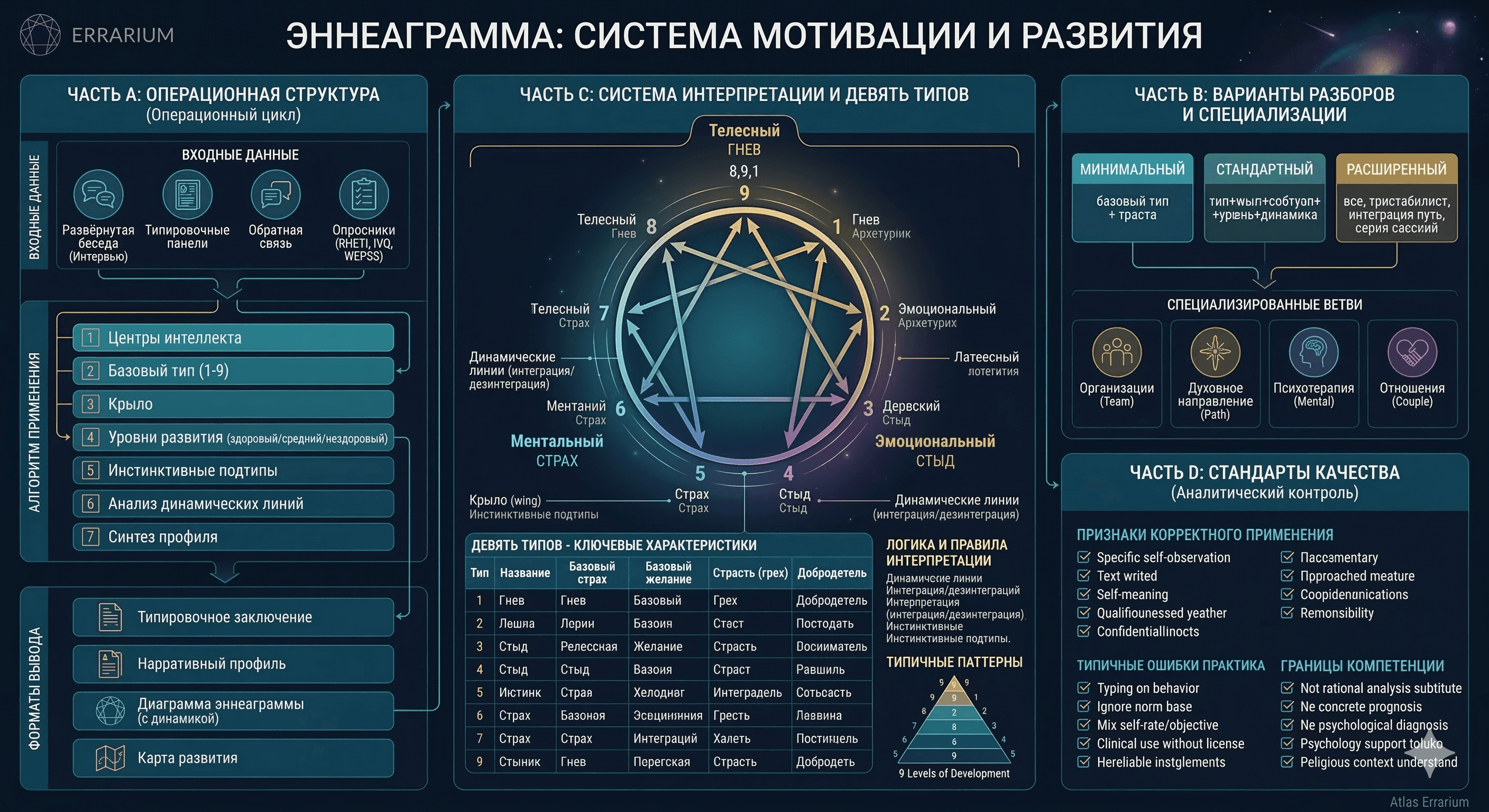
ON THE SPECIFICS OF THE METHOD
The Enneagram is a typological system describing nine basic patterns of motivation, perception, and behavior. Unlike psychometric models (Big Five), the Enneagram describes not traits but deep motivations: what a person fears, what they strive for, how they avoid suffering. The system unites Sufi, Christian mystical, and psychological traditions. The central symbol is a nine-pointed figure with internal lines that define the dynamics between types.
PART A: WORKING ALGORITHM
Input Data
Primary method of type determination — self-observation and interview:
- In-depth conversation about motivations, fears, habitual strategies (not about behavior)
- Typing panels: the person listens to type descriptions and recognizes themselves
- Feedback from close ones (additionally)
Questionnaires (auxiliary):
- RHETI (Riso-Hudson Enneagram Type Indicator) — 144 questions, the most widely used
- IVQ (Instinctual Variant Questionnaire) — additionally determines the instinctual subtype
- Wagner Enneagram Personality Style Scales (WEPSS) — research instrument
Specifics:
- Questionnaires in the Enneagram are less reliable than in Big Five: type is determined by motivation, not behavior, which is harder to capture with a standardized question
- The gold standard is prolonged self-observation + work with a qualified teacher
- Type determination can take from one session to several months
Application Algorithm
Step 1. Determining the Center of Intelligence Three centers: body (types 8, 9, 1 — anger), emotional (types 2, 3, 4 — shame), mental (types 5, 6, 7 — fear). Determining the dominant center is the first step toward the type.
Step 2. Determining the Basic Type (1–9) Through interview, panels, or questionnaire. The key question: not "what do you do?" but "why? what drives you?"
Step 3. Determining the Wing Each type sits between two neighbors. The wing is the adjacent type that colors the main one. Example: 4w5 (Four with a Five wing) — a different dynamic than 4w3.
Step 4. Determining the Level of Development According to the Riso-Hudson model: 9 levels of development from healthy (1–3) through average (4–6) to unhealthy (7–9). The level determines how the type manifests — as a resource or as a trap.
Step 5. Determining the Instinctual Subtype Three instincts: self-preservation (sp), sexual / one-on-one (sx), social (so). Dominant instinct × type = 27 subtypes.
Step 6. Analysis of Dynamic Lines
- Line of integration (growth): in security, the type moves toward a specific other type
- Line of disintegration (stress): under stress, the type takes on unhealthy traits of another type
- Example: Type 1 → in growth acquires the lightness of the Seven; under stress — the self-criticism of the Four
Step 7. Profile Synthesis Type + wing + subtype + level of development + dynamic lines = individual profile.
Output Formats
- Typing conclusion: type, wing, presumed subtype, level of development
- Narrative profile: description of core motivation, defense strategy, growth zones
- Enneagram diagram: nine-pointed figure with the type, wings, and dynamic lines marked
- Development map: recommendations for integration (specific practices for the given type)
PART B: ANALYSIS VARIANTS
Minimal Reading
Determination of the basic type + brief characteristics of the core motivation, fear, and defense strategy. Without wing, subtype, or levels. Format: 30–45 minutes.
Standard Reading
Type + wing + instinctual subtype + level of development. Description of dynamic lines. Growth recommendations. Format: 60–90 minutes.
Extended Reading
All elements of the standard + tri-fix analysis (stacking of three instincts), work with "movement" along lines of integration/disintegration, interaction with types of significant others. May include a prolonged process (series of sessions). Format: 3–5 meetings.
Specialized Branches
1. Enneagram in Organizations Team dynamics: how types interact, which conflicts are predictable. Applied in leadership and team-building trainings (Ginger Lapid-Bogda, The Enneagram in Business).
2. Enneagram in Spiritual Direction Passion and virtue of each type as a map for spiritual work. Tradition: Ichazo (Arica), Naranjo (SAT program), Father Richard Rohr (Christian contemplative tradition).
3. Enneagram in Psychotherapy Integration with Gestalt therapy, cognitive-behavioral therapy, psychodynamic approaches. Type as a "character map" (character structure). Practiced by licensed therapists.
4. Enneagram in Relationships Analysis of couples by type: which patterns of attraction and conflict are characteristic for each combination. Helen Palmer, David Daniels — research in this area.
PART C: INTERPRETATION SYSTEM
Nine Types — Key Characteristics
| Type | Name | Basic Fear | Basic Desire | Passion (Sin) | Virtue |
|---|---|---|---|---|---|
| 1 | Reformer | Being bad, corrupt | Being good, whole | Anger (resentment) | Serenity |
| 2 | Helper | Being unloved | Being loved | Pride | Humility |
| 3 | Achiever | Being worthless | Being valuable | Deceit (vanity) | Truthfulness |
| 4 | Individualist | Having no identity | Being oneself | Envy | Equanimity |
| 5 | Investigator | Being incompetent | Being competent | Avarice | Non-attachment |
| 6 | Loyalist | Being without support | Having security | Fear | Courage |
| 7 | Enthusiast | Being in pain, deprived | Being satisfied | Gluttony | Sobriety |
| 8 | Challenger | Being controlled | Protecting oneself | Lust (excess) | Innocence |
| 9 | Peacemaker | Loss, separation | Inner peace | Sloth (acedia) | Action |
Logic and Interpretation Rules
1. Motivation is primary, behavior is secondary. Two people may behave the same way (helping others), but for different reasons: the Two — out of the need to be needed; the Nine — to avoid conflict; the One — from a sense of duty.
2. One type for life. The type does not change. What changes is the level of development: a healthy Four is not the same as an unhealthy one. Growth is not a change of type but development within the type.
3. Dynamic lines are not a verdict. Movement toward the type of disintegration (stress) is not a "fall"; it is a signal that the habitual strategy has stopped working. Awareness of the disintegration line = prevention.
4. Subtype radically modifies manifestation. A Social Four looks different from a Sexual Four — so much so that they may be mistaken for different types. This is the source of most typing errors.
5. Wings are not an addition but a coloring. 6w5 and 6w7 are two different variants of the Six: the first is more introverted and analytical, the second more sociable and active.
6. Three centers — three basic energies. Body center (8-9-1): theme of anger and autonomy. Emotional (2-3-4): theme of image and identity. Mental (5-6-7): theme of security and orientation.
Typical Patterns
1. "The Helper in a Trap" (Two at a Low Level) Giving in order to receive. Inability to ask directly. Resentment toward those who do not appreciate the sacrifice. Integration: learning to receive without giving.
2. "The Perfectionist-Prosecutor" (One Under Stress) The inner critic is directed outward. Rigidity, moralizing. Line of disintegration to the Four: sudden melancholy and self-examination.
3. "The Chameleon" (Three) Adapting to the expectations of the environment to the point of losing contact with one's own feelings. Success as an addiction. Integration: through the honesty of the Six — stopping and asking "but what do I want?"
4. "The Observer in the Tower" (Five) Retreat into the mental world. Accumulating knowledge as a security strategy. Difficulty with emotional presence. Integration: through the Eight — action, embodiment, participation.
5. "The Loyalist in a Loop" (Six) Doubt → search for authority → doubt about the authority → new search. Counterphobic Six: masks fear with aggression. Integration: through the Nine — trusting the process.
PART D: QUALITY STANDARDS
Signs of Correct Application
- Type determination is based on motivation, not on external behavior
- The practitioner distinguishes between type and level of development
- The full model is used: type + wing + subtype + dynamic lines
- Interpretation does not reduce to labeling but reveals the inner dynamic
- The type is confirmed by the person themselves through a process of self-observation
Typical Practitioner Errors
-
Typing by behavior. "He's a leader — so he's an Eight." Threes, Ones, and counterphobic Sixes are also leaders. Type is determined by "why," not by "what."
-
Typing in minutes. Claiming "I can see you're a Four" after 5 minutes of acquaintance. Reliable determination requires deep conversation or prolonged self-observation.
-
Using type as an excuse. "I'm a Seven, so I can't finish things." Type describes a tendency, it does not grant indulgence.
-
Ignoring subtypes. A Social Two (ambitious, influential) is radically different from a Self-Preservation Two (domestic, nurturing). Without the subtype, typing is incomplete.
-
Mixing schools without reflection. Riso-Hudson, Naranjo, Palmer, Chestnut use different terminology and different emphases. The practitioner must know their own lineage.
Typical Interpretation Errors
-
"Good" and "bad" types. Nine is not the "best type" (peacemaker); at a low level, it is apathy, avoidance, withdrawal from reality.
-
Linear reading of lines. "A Five under stress goes to Seven — so they start having fun." In reality, a Five under stress takes on unhealthy traits of the Seven: scatteredness, avoidance of depth, superficial stimulation.
-
Typing celebrities with certainty. Without access to a person's motivation, typing remains speculation.
Competence Boundaries
- Not a psychodiagnostic instrument. The Enneagram does not replace clinical assessment
- Not psychotherapy. Type determination is the beginning of work, not its completion
- In cases of pronounced psychological symptoms — referral to a licensed specialist
- Not used for personnel selection as the sole criterion: insufficient psychometric validation
- Does not predict behavior in specific situations
PART E: THEORETICAL BASE
Primary Sources
- George Gurdjieff — brought the Enneagram symbol (nine-pointed figure) into Western esotericism (1910s–1940s); used it as a cosmological diagram, not as a personality typology
- Oscar Ichazo — developed nine "ego fixations" and linked them to the Enneagram symbol (Arica Institute, Chile, 1960s–1970s)
- Claudio Naranjo — psychiatrist, student of Ichazo; integrated the Enneagram with character psychology and Gestalt therapy; taught in the SAT program (1970s–2010s)
Schools and Authorities
- Don Richard Riso & Russ Hudson — The Enneagram Institute; "levels of development" system; RHETI questionnaire; books: Personality Types (1987), The Wisdom of the Enneagram (1999)
- Helen Palmer — narrative Enneagram tradition; panel interviews; The Enneagram (1988)
- David Daniels — Stanford Enneagram program; integration with medicine
- Beatrice Chestnut — detailed development of 27 subtypes; The Complete Enneagram (2013)
- Claudio Naranjo — Character and Neurosis (1994); linking types to DSM categories
- Richard Rohr — Franciscan friar; the Enneagram as an instrument of Christian spirituality; The Enneagram: A Christian Perspective (2001)
- A.H. Almaas (A. Hameed Ali) — integration of the Enneagram with the Diamond Approach
Current State
- Largest organization: International Enneagram Association (IEA), annual conferences
- Education: Enneagram Institute (online), Narrative Enneagram (Palmer-Daniels), The Enneagram in Business (Lapid-Bogda)
- Scientific validation: limited; several RHETI studies have shown moderate reliability (test-retest ~0.72–0.84); factor structure partially confirmed
- Criticism: Sutton (2012) notes weak discriminant validity; Hook et al. (2021) — review of limitations
- Popularity is growing: podcasts, Instagram accounts, corporate trainings; risk — oversimplification of the system to memes
- Debates: origin (Sufi tradition vs. Ichazo's authorship), scientific legitimacy, commercialization
PART F: PRACTICAL FORMATS
Session / Consultation Formats
Individual Typing Session:
- Duration: 60–120 minutes
- Format: in-person or remote
- Procedure: interview about motivations → preliminary type determination → discussion → homework (self-observation)
Panel Interview (Group):
- 6–15 participants; the facilitator describes a type, people of that type share their experience
- Others listen and try it on for themselves
- Format of Helen Palmer / Narrative Enneagram
Corporate Training:
- 1–2 days; team of 10–20 people
- Typing + interaction dynamics + conflict work
- Requires a certified facilitator
Long-Term Work (Growth):
- Series of meetings (8–12 sessions) with a focus on development through the line of integration
- May include meditative practices, bodywork, a self-observation journal
Frequent User Questions
- What is my type?
- Can my type change?
- Which type is best / worst?
- How do I become the healthy version of my type?
- Are my partner and I compatible by type?
- Where did the Enneagram come from — is it a scientific system?
- How does the Enneagram differ from MBTI?
- What is a "wing" and why does it matter?
- Can I be two types at once?
- How do I work with my Six / Four / etc.?
Descriptive Fragment Examples
Fragment 1 — type determination: "In your description, the theme of an inner standard consistently comes through: 'how it should be' vs. 'how it is.' You notice errors, imperfections, deviations — and feel an inner tension. This is the pattern of the One: the world is perceived through a filter of 'correctness.' Your growth lies not in abandoning standards, but in developing inner serenity: the ability to see imperfection without reacting with anger."
Fragment 2 — subtype: "You describe yourself as an introverted Two, which at first glance contradicts the stereotype. But the Self-Preservation Two (sp/2) looks exactly like this: care is expressed not publicly, but through creating comfort, cooking meals, silently providing well-being. This is the 'privilege of care' — you choose to whom you give your energy, rather than distributing it to everyone."
PART G: PLATFORM COMPATIBILITY
Recommended Combinations
MBTI (#4) / Socionics (#8) Different levels of personality description: MBTI describes cognitive preferences, the Enneagram — the motivational core. An INTJ can be a One, a Five, or a Three — MBTI shows "how one thinks," the Enneagram — "why."
Jungian Archetypes (#11) The nine Enneagram types have parallels with Jungian archetypes: the Eight — the Warrior, the Four — the Wounded Healer, the Nine — the Sage. The combination enriches symbolic understanding.
Directed Attention Practices (#12) The Enneagram indicates "what to observe" (fixation pattern), attention practices — "how to observe" (without judgment, with presence). A natural combination for transformational work.
Incompatible Combinations
- Big Five (#3): Attempting to "translate" Enneagram types into Big Five scores — mixing typological and measurement logics
- Astrology (#1, #18): "Twos are often Cancers" — an unverifiable statement creating a false correlation between systems
What the Method Does Not Replace
- Psychotherapy — type determination is not treatment
- Clinical diagnostics — the Enneagram is part of neither DSM nor ICD
- Psychometric testing (for personnel selection) — insufficient validation for high-stakes decisions
- Spiritual practice — the Enneagram can be a map of the path, but the path itself requires discipline, not typing
SOURCES
- Riso D.R., Hudson R. Personality Types: Using the Enneagram for Self-Discovery. Boston: Houghton Mifflin, 1996 (revised ed.).
- Riso D.R., Hudson R. The Wisdom of the Enneagram. New York: Bantam Books, 1999.
- Palmer H. The Enneagram: Understanding Yourself and the Others in Your Life. San Francisco: Harper & Row, 1988.
- Naranjo C. Character and Neurosis: An Integrative View. Nevada City: Gateways/IDHHB, 1994.
- Chestnut B. The Complete Enneagram: 27 Paths to Greater Self-Knowledge. Berkeley: She Writes Press, 2013.
- Rohr R., Ebert A. The Enneagram: A Christian Perspective. New York: Crossroad Publishing, 2001.
- Lapid-Bogda G. Bringing Out the Best in Yourself at Work: How to Use the Enneagram System for Success. New York: McGraw-Hill, 2004.
- Hook J.N. et al. "The Enneagram: A Systematic Review of the Literature and Directions for Future Research." Journal of Clinical Psychology 77(4), 2021: 865–883.
- Sutton A. "But Is It Real? A Review of Research on the Enneagram." Enneagram Journal 5(1), 2012: 5–25.
PART H: SOURCES
Canonical Texts of the Tradition
- Ichazo, Oscar (1972). Lectures at the Arica Institute. — The first systematization of nine fixation points (prototypes).
- Naranjo, Claudio (1994). Character and Neurosis: An Integrative View. Gateways/IDHHB. — Psychiatric interpretation of the nine types.
- Gurdjieff, G.I. (1950). Beelzebub's Tales to His Grandson. Harcourt, Brace. — The esoteric context of the Enneagram symbol.
- Ouspensky, P.D. (1949). In Search of the Miraculous. Harcourt, Brace. — Exposition of Gurdjieff's teaching; description of the Enneagram symbol.
- Riso, Don Richard & Hudson, Russ (1996). Personality Types: Using the Enneagram for Self-Discovery. Revised ed. Houghton Mifflin. — Systematization of levels of development.
Research and Critical Works
- Wagner, Jerome P. (2010). Nine Lenses on the World: The Enneagram Perspective. NineLens Press. — Academic overview of the system.
- Newgent, Rebecca A. et al. (2004). The Riso-Hudson Enneagram Type Indicator: Estimates of reliability and validity. Measurement and Evaluation in Counseling and Development, 36(4), 226–237.
- Sutton, Allison (2012). But is it real? A review of research on the Enneagram. Enneagram Journal, 5(1), 5–25.
- Hook, Joshua N. et al. (2021). Measuring the Enneagram: Development of the Enneagram Personality Assessment. Journal of Personality Assessment, 103(6), 762–775.
Reference and Educational Publications
- Palmer, Helen (1988). The Enneagram: Understanding Yourself and the Others in Your Life. HarperSanFrancisco. — Classic introduction; intuitive method.
- Riso, Don Richard & Hudson, Russ (1999). The Wisdom of the Enneagram. Bantam Books. — Complete guide with transformation practices.
- Chestnut, Beatrice (2013). The Complete Enneagram: 27 Paths to Greater Self-Knowledge. She Writes Press. — Subtypes (instinctual variants).
- Lapid-Bogda, Ginger (2004). Bringing Out the Best in Yourself at Work: How to Use the Enneagram System for Success. McGraw-Hill. — Business application.
- Maitri, Sandra (2000). The Spiritual Dimension of the Enneagram. Tarcher. — Connection of the Enneagram with spiritual traditions.
- Daniels, David & Price, Virginia (2009). The Essential Enneagram. Revised ed. HarperOne. — Brief self-diagnostic introduction.
Deep Method #9 — Enneagram v1.0 — Errarium Project. Parts A–C — language of the Enneagram tradition. Parts D–G — neutral analytical language. The method describes motivational patterns; it is not a psychodiagnostic instrument and does not replace professional psychological help.
Method Info
#9Enneagram
Data D3+D0
Causality C3+C1
Time T3
Result F1, F2, F4, F5