
Ba Zi (Four Pillars of Destiny)
 Astrological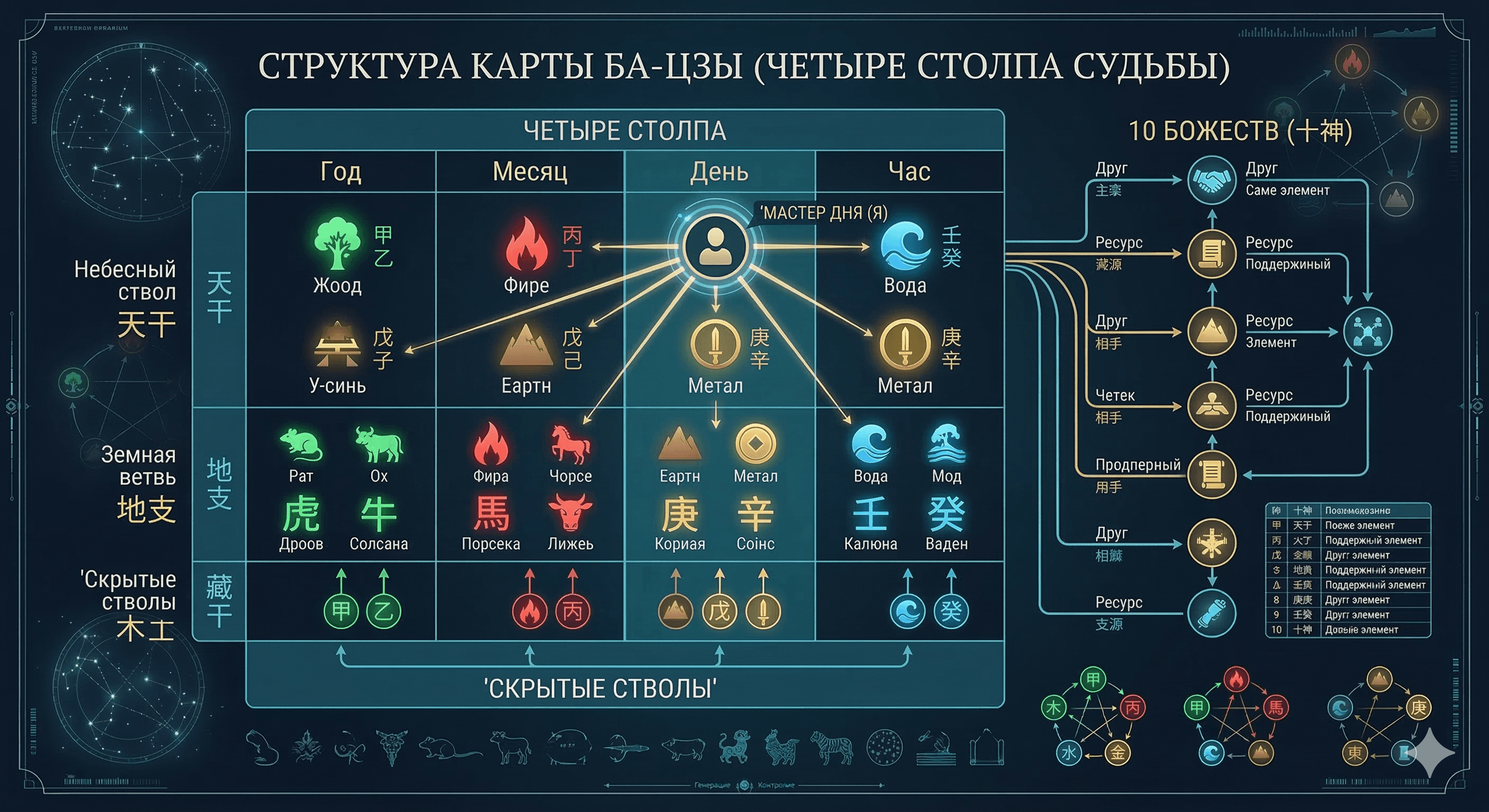
ON THE SPECIFICS OF THE METHOD
Ba Zi (八字, "Eight Characters," also "Four Pillars of Destiny," 四柱命理) is one of the central systems of Chinese metaphysics, reading a person's destiny through the elemental structure of the moment of birth. Unlike Western astrology, which operates with planets and houses, Ba Zi works exclusively with the Five Elements (五行 Wu Xing) and their interactions: generation, control, weakening, destruction. The birth chart is not a horoscope in the conventional sense but an elemental formula of eight characters arranged in four pillars (year, month, day, hour). Each pillar is a pair: a Heavenly Stem above and an Earthly Branch below.
The central principle of the system: the Day Master (日主 Ri Zhu) — the Heavenly Stem of the day pillar — is the "self" in the chart. All other elements are analyzed in relation to it: what generates it, what controls it, what weakens it. From these relationships arises the system of ten "gods" (十神 Shi Shen) — roles that the chart's elements play. It is through the gods that character, relationships, career, health, events, and life periods are read.
Ba Zi is fundamentally dynamic: the static birth chart interacts with current time streams — ten-year Luck Periods (大運 Da Yun) and annual flows (流年 Liu Nian). An event in Ba Zi is a point at which the elements of the natal chart and the temporal flow form sufficient tension or support for manifestation. This mechanism makes the system simultaneously structural (C1), cyclical (C2), and symbolic (C3) — a unique combination in the Errarium atlas.
PART A: WORKING ALGORITHM
Input Data
Required:
- Date of birth: year, month, day — according to the Gregorian or lunar calendar
- Hour of birth: required for constructing the hour pillar; without it, analysis is possible but incomplete (three pillars instead of four)
Additional:
- Place of birth — for adjusting true solar time (真太陽時 Zhen Taiyang Shi); time zones and daylight saving time introduce distortions
- Gender — determines the direction of movement through Luck Periods (forward or reverse)
Accuracy requirements:
- Accuracy of the hour is critical: an error of 1–2 hours can change the hour pillar and reconfigure the entire chart
- Solar calendar (节气 Jie Qi): the beginning of a month in Ba Zi is determined not by the 1st day but by the solar term (24 seasons). The practitioner must use an exact conversion calendar
- Beginning of the year — Li Chun (立春, beginning of spring, ~February 4th), not January 1st and not Chinese New Year
Application Algorithm
Step 1. Converting Date and Time of Birth Converting the Gregorian date to the Chinese solar calendar. Determining the exact boundaries of the month (by Jie Qi) and the hour (by the 12 two-hour periods — 時辰 Shi Chen). Correction for true solar time.
Step 2. Constructing the Four Pillars Each pillar is a "Heavenly Stem + Earthly Branch" pair:
- Year pillar (年柱): determined by Li Chun
- Month pillar (月柱): determined by the solar term
- Day pillar (日柱): determined from the Wan Nian Li tables (万年历)
- Hour pillar (時柱): determined by the two-hour period
Step 3. Identifying the Day Master The Heavenly Stem of the day pillar = "self" in the chart. The entire coordinate system is built from it.
Step 4. Determining the Strength of the Day Master Analysis: which elements of the chart support the Master (resource + parallels), which weaken it (self-expression + wealth + authority). The birth season is considered: an element in "its" season is stronger.
Step 5. Assigning the Ten Gods Each element in the chart receives a role relative to the Day Master (see table in Part C). This is the key analytical step.
Step 6. Analyzing Hidden Stems Within each Earthly Branch, 1–3 Heavenly Stems are "hidden" (藏干 Cang Gan). They manifest covertly but affect element strength and form additional relationships.
Step 7. Analyzing Interactions
- Clashes (沖 Chong): opposing branches destroy stability
- Combinations (合 He): branches or stems unite, generating a new element
- Punishments (刑 Xing): conflicting triangles of branches — hidden tensions
- Destructions (破 Po) and Harm (害 Hai): additional conflicting connections
- Emptiness (空亡 Kong Wang): certain branches are "de-energized" — themes are weakened
Step 8. Calculating Luck Periods (Da Yun) The starting age of entry into the first period is determined. Each period = 10 years, defined by a stem-branch pair. Direction — from the month pillar: forward (for a yang year stem + male gender or yin + female) or reverse (otherwise).
Step 9. Overlaying Annual Flows (Liu Nian) The current year introduces its own stem-branch pair. The interaction of the flow with the natal chart and the current period is analyzed.
Step 10. Synthesis and Interpretation Final reading: strengths and weaknesses of personality, favorable and tense periods, key life themes, navigation strategy.
Ba Zi Algorithm:

  DATE + HOUR OF BIRTH
         |
         v
  +---------------------------+
  |  CONVERSION TO CHINESE    |
  |  SOLAR CALENDAR           |
  +-----------+---------------+
              v
  +-----------------------------------------------+
  |         FOUR PILLARS (八字)                     |
  |  YEAR    MONTH    DAY      HOUR                |
  |  甲子    丙寅     壬午      庚子                |
  |  Stem    Stem    [MASTER]  Stem                |
  |  Branch  Branch   Branch   Branch              |
  +-----------+-----------------------------------+
              v
  +------------------------+
  | DAY MASTER STRENGTH    |---- strong / weak / special structure
  +----------+-------------+
             v
  +------------------------+
  | 10 GODS (十神)          |---- roles of all elements
  +----------+-------------+
             v
  +------------------------+
  | HIDDEN STEMS (藏干)     |---- reservoir of hidden themes
  +----------+-------------+
             v
  +------------------------+
  | INTERACTIONS           |---- 沖 合 刑 破 害 空亡
  +----------+-------------+
             v
  +------------------------+      +--------------------+
  | LUCK PERIODS (大運)     | <--> | ANNUAL FLOWS       |
  | 10 years each           |      | (流年 Liu Nian)     |
  +----------+-------------+      +--------+-----------+
             +----------+----------------+
                        v
              +------------------+
              | SYNTHESIS:       |
              | character,       |
              | events, periods, |
              | strategy         |
              +------------------+
Output Formats
- Ba Zi Chart (四柱命盤): table of four pillars with Heavenly Stems, Earthly Branches, hidden stems, and gods; accompanied by an indication of Day Master strength
- Luck Period Table: chronological scale of ten-year periods with elements and entry age
- Written Reading: structured text (character → relationships → career → health → key periods → recommendations)
- Oral Consultation: the primary format; 60–120 minutes; the practitioner comments on the chart in dialogue
- Annual Forecast: reading of the current or upcoming year against the backdrop of the natal chart and period
PART B: ANALYSIS VARIANTS
Minimal Reading
Input data: date of birth (without hour).
Content: three pillars → Day Master identification → Master strength → basic elemental profile → main gods → general characteristics.
What is not included: hour pillar, hidden stems, Luck Periods, forecasting.
Format: oral or short written summary; 30–40 minutes.
Application: first introduction to the system; express consultation; situation where the birth hour is unknown.
Standard Reading
Input data: date of birth + exact hour + gender.
Content:
- Four pillars with full decoding
- Day Master: element, polarity, strength
- Ten gods: which are present, absent, dominant
- Hidden stems: what is concealed within the branches
- Key interactions: clashes, combinations, punishments
- Luck Periods: table + characteristics of the current and nearest periods
- Synthesis: character, relationships, career, health
Format: written reading + oral session; 90–120 minutes.
Extended Reading
Additional content:
- Analysis of annual and monthly flows (流年 + 流月 Liu Yue) for the coming year
- Compatibility check with a partner (paired analysis of two charts)
- Selection of favorable dates for significant actions (wedding, business launch, relocation)
- Analysis of special chart structures (专旺格, 从格, 化气格 — "following" and "transforming" structures)
- Detailed reading of the "spouse palace" (配偶宫), "children palace" (子女宫), "career palace"
Specialized Branches
1. Date Selection (择日 Ze Ri) Selecting a favorable date and hour for an important action. The practitioner analyzes the client's chart and finds a day whose elemental composition is most favorable. A separate discipline with its own rules.
2. Compatibility Analysis (合婚 He Hun) Paired analysis of two charts: element compatibility, clashes and combinations between charts, mutual influence of Luck Periods. Applied for marital and business partnerships.
3. Health Analysis (疾病 Ji Bing) Each element is linked to organs (Wood — liver, Fire — heart, Earth — spleen, Metal — lungs, Water — kidneys). Imbalances in the chart indicate vulnerable zones. Does not replace medical diagnostics.
4. Child's Chart Analysis of a child's chart for understanding character, abilities, potential difficulties. Specifics: early Luck Periods are key.
5. Business Ba Zi Analysis of the business owner's chart in the context of entrepreneurship: favorable industries (by elements), optimal periods for launch, hiring, expansion.
PART C: INTERPRETATION SYSTEM
Dictionary of Key Elements
Five Elements (五行 Wu Xing)
| Element | Chinese | Generates | Controls | Weakened by | Controlled by |
|---|---|---|---|---|---|
| Wood (木) | Mu | Fire | Earth | Metal | — |
| Fire (火) | Huo | Earth | Metal | Water | — |
| Earth (土) | Tu | Metal | Water | Wood | — |
| Metal (金) | Jin | Water | Wood | Fire | — |
| Water (水) | Shui | Wood | Fire | Earth | — |
10 Heavenly Stems (天干 Tian Gan)
| # | Stem | Pinyin | Element | Polarity |
|---|---|---|---|---|
| 1 | 甲 | Jia | Wood | Yang |
| 2 | 乙 | Yi | Wood | Yin |
| 3 | 丙 | Bing | Fire | Yang |
| 4 | 丁 | Ding | Fire | Yin |
| 5 | 戊 | Wu | Earth | Yang |
| 6 | 己 | Ji | Earth | Yin |
| 7 | 庚 | Geng | Metal | Yang |
| 8 | 辛 | Xin | Metal | Yin |
| 9 | 壬 | Ren | Water | Yang |
| 10 | 癸 | Gui | Water | Yin |
12 Earthly Branches (地支 Di Zhi)
| # | Branch | Animal | Element | Hidden Stems |
|---|---|---|---|---|
| 1 | 子 Zi | Rat | Water | 癸 |
| 2 | 丑 Chou | Ox | Earth | 己 癸 辛 |
| 3 | 寅 Yin | Tiger | Wood | 甲 丙 戊 |
| 4 | 卯 Mao | Rabbit | Wood | 乙 |
| 5 | 辰 Chen | Dragon | Earth | 戊 乙 癸 |
| 6 | 巳 Si | Snake | Fire | 丙 戊 庚 |
| 7 | 午 Wu | Horse | Fire | 丁 己 |
| 8 | 未 Wei | Goat | Earth | 己 丁 乙 |
| 9 | 申 Shen | Monkey | Metal | 庚 壬 戊 |
| 10 | 酉 You | Rooster | Metal | 辛 |
| 11 | 戌 Xu | Dog | Earth | 戊 辛 丁 |
| 12 | 亥 Hai | Pig | Water | 壬 甲 |
10 Gods (十神 Shi Shen)
| God | Chinese | Relation to Day Master | Key Meanings |
|---|---|---|---|
| Rob Wealth (劫财) | Jie Cai | Same element, opposite polarity | Competition, siblings, ambition, losses |
| Friend (比肩) | Bi Jian | Same element, same polarity | Support, peers, partnership, independence |
| Eating God (食神) | Shi Shen | Generated, same polarity | Creativity, pleasure, food, self-expression |
| Hurting Officer (伤官) | Shang Guan | Generated, opposite polarity | Rebellion, talent, unconventionality, conflict with authority |
| Direct Wealth (正财) | Zheng Cai | Controlled, opposite polarity | Stable income, wife (in male chart), order |
| Indirect Wealth (偏财) | Pian Cai | Controlled, same polarity | Unexpected income, father, investments, generosity |
| Direct Officer (正官) | Zheng Guan | Controlling, opposite polarity | Career, status, discipline, husband (in female chart) |
| Seven Killings (七杀) | Qi Sha | Controlling, same polarity | Pressure, power, risk, decisiveness, danger |
| Direct Seal (正印) | Zheng Yin | Generating, opposite polarity | Mother, education, patronage, authority |
| Indirect Seal (偏印) | Pian Yin | Generating, same polarity | Unconventional thinking, solitude, intuition |
Logic and Interpretation Rules
Day Master is the reference point. All elements of the chart are read only through their relationship to the Day Master. The same element (e.g., Fire) plays different roles in different charts — depending on who the Master is.
Master strength determines the strategy. A strong Master needs to expend energy (self-expression, wealth, authority); a weak one needs support (resource, parallels). This basic division determines which elements are favorable and which create overload.
Special structures (格局 Ge Ju). If the balance of forces in the chart is extreme, special rules apply. "Following" structure (从格 Cong Ge): the Master is so weak that it "follows" the dominant element. "Transforming" structure (化气格 Hua Qi Ge): certain stem combinations change the elemental nature of the chart.
Absence of an element is significant. If any element is entirely absent from the chart, the corresponding life theme is "unfilled" — it manifests unstably or requires compensation.
Temporal flows activate statics. The natal chart is potential; an event occurs when the Luck Period or annual flow brings an element that completes a certain configuration (clash, combination, filling of emptiness).
Clashes are not always bad. 沖 can mean destruction of stability, but also activation of stuck energy. Context is determined by the overall configuration of the chart.
Typical Patterns
1. Strong Master + Absence of Wealth A person with excess energy and weak motivation for accumulation. Manifests as a doer not oriented toward financial results. A Luck Period bringing the Wealth element can activate the financial theme — provided the Master is strong enough to "control" it.
2. Weak Master + Strong Authority (七杀 or 正官) Pressure exceeds resources. The person feels chronic overload: work, obligations, external demands. The key is the presence of the Seal (印), which transforms the pressure of Authority into support.
3. Clash Between Day and Hour Branches Inner conflict between the "outer self" (day) and the "inner self" (hour). May manifest as inner restlessness, instability in close relationships (the hour pillar is connected to children and the inner world).
4. Combination of Month and Day Pillars Harmony between the social environment (month) and personality (day). The person finds it relatively easy to integrate into the professional environment and realize their potential.
5. Three Punishments (三刑 San Xing) in the Natal Chart 寅–巳–申 (Tiger–Snake–Monkey) or 丑–未–戌 (Ox–Goat–Dog). Hidden tension that manifests in conflict situations. Not a "verdict" but an indication of zones of heightened tension requiring conscious navigation.
6. Emptiness (空亡) on the Spouse Pillar The Earthly Branch of the day pillar is in Emptiness. The marriage theme is "de-energized" — does not mean impossibility but indicates an unconventional path in relationships, delays, or non-conventional forms.
7. Transition Between Luck Periods (交運 Jiao Yun) A shift in the elemental "climate" every 10 years. Transition years (+-1-2 years from the changeover point) are a period of instability and recalibration. The practitioner warns of the shift and helps prepare.
PART D: QUALITY STANDARDS
Signs of Correct Application
- The birth hour is verified and adjusted for true solar time
- The month is determined by the solar term (Jie Qi), not by the lunar or Gregorian calendar
- The year is determined by Li Chun, not by January 1st or Chinese New Year
- Hidden stems are accounted for when calculating Day Master strength
- Interpretation is based on the holistic configuration of the chart, not on individual elements
- Luck Periods are calculated accounting for gender and the polarity of the year stem
- The practitioner explicitly distinguishes between the chart's potential and a specific forecast
Typical Practitioner Errors
-
Incorrect time conversion. Using the time zone without correction for true solar time. An error in the hour means a different hour pillar means a different chart.
-
Determining the month by the lunar calendar. Ba Zi uses the solar calendar (24 seasons), not the lunar one. Confusion arises from mixing with other Chinese systems.
-
Ignoring hidden stems. Analyzing only the four visible Heavenly Stems impoverishes the chart: up to 60% of the elemental composition is hidden within the Earthly Branches.
-
Mechanical application of formulas without considering context. "You have a clash — it will be a bad year" — without analyzing which elements are affected and how this relates to the overall structure.
-
Predicting specific events. Ba Zi describes the elemental conditions of a period, not specific occurrences. "In 2027 you will divorce" — beyond the scope of correct application.
-
Ignoring special structures. Applying "strong/weak Master" rules to charts with special structures (从格, 化气格) yields inverted conclusions.
Typical Interpretation Errors
-
Literal reading of god names. "Seven Killings" is not a threat to life; "Rob Wealth" does not necessarily mean financial losses. The names are metaphorical and describe the quality of energy.
-
Evaluating elements as "good" and "bad." In Ba Zi there are no absolutely favorable or unfavorable elements — their role is determined by the chart's context.
-
Identifying the Earthly Branch only with the animal. "You are a Dragon" — reduction of a complex system to one of twelve archetypes. The Branch is a container of hidden elements, not a characterization.
-
Direct transfer of Western astrological concepts. Ba Zi does not work with planets, houses, or aspects. Attempting to "translate" one system into the other destroys the logic of both.
Competence Boundaries
- Not a psychological diagnostic instrument. Ba Zi describes elemental tendencies, not mental disorders or clinical conditions
- Does not replace medical examination. Element–organ connections are symbolic; they are not equivalent to medical diagnosis
- Does not predict specific events. Describes the quality and potential of a period, not dates and facts
- Requires interpreter qualification. The complexity of the system is such that self-interpretation from a book is prone to serious distortions
- Determinism is a school-dependent question. Some schools interpret the chart rigidly ("this is your destiny"), others flexibly ("this is potential you can work with"). The practitioner must be aware of their position and not impose fatalism
PART E: THEORETICAL BASE
Primary Sources
- Yuan Tiangang (袁天罡, 7th c.) and Li Xuzhong (李虚中, 8th c.) — early forms of the system: analysis by three pillars (year, month, day); the hour was not yet used
- Xu Ziping (徐子平, 10th–11th c.) — the key reform: introduction of the fourth (hour) pillar and shifting the focus to the Day Master. Modern Ba Zi is called the "Ziping method" (子平法)
- "Yuanhai Ziping" (渊海子平) — the principal canonical text, attributed to the students of Xu Ziping; systematization of rules
- "Sanming Tonghui" (三命通会, 16th c.) — Wan Minying (万民英); encyclopedic compilation of theory and practice
- "Ditian Sui" (滴天髓) — one of the most revered texts; philosophical foundation of interpretation; commentary by Ren Tiejiao (任铁樵, 19th c.)
Schools and Authorities
- Classical Ziping School — the main stream; emphasis on Day Master strength and the ten gods
- Blind Masters School (盲派 Mang Pai) — oral tradition transmitted by blind practitioners; specific formulas and poetic imagery; a closed system
- Structure School (格局派 Ge Ju Pai) — focus on determining the chart structure as the primary step; various authors define structures differently
- Taiwanese School — Liang Xiangrun (梁湘润), Chen Yuanbo, and others; academic systematization of classical texts
- Malaysian and Singaporean School — Joey Yap, Lillian Too; popularization of Ba Zi in English; educational programs; criticized by traditionalists for oversimplification
- Jerry King — Western author; attempts at systematization in English
Current State
- Ba Zi continues to be actively practiced in China, Taiwan, Hong Kong, Singapore, and Malaysia — by professional masters and in everyday life
- Growing interest in the West: translations of classical texts, online schools, software calculators
- Software (BaZi Calculator, Joey Yap BaZi Profiling) automates pillar calculation, but interpretation remains the practitioner's task
- Academic sinology studies Ba Zi as a cultural phenomenon; systematic scientific studies of effectiveness do not exist
- Debate within the tradition: different schools give different interpretations of the same chart; standardization is absent
PART F: PRACTICAL FORMATS
Session / Consultation Formats
Individual Consultation (primary format):
- Duration: 60–120 minutes
- Preliminary: the client provides the exact date, hour of birth, and gender
- The practitioner builds the chart and prepares a preliminary analysis in advance
- Format: dialogue; the practitioner explains the chart, answers questions, provides recommendations
- Result: written chart + brief report with key findings
Annual Forecast:
- Duration: 30–60 minutes
- For existing clients with an already analyzed chart
- Focus: current annual flow, key months, recommendations
Paired Consultation (Compatibility):
- Duration: 90–120 minutes
- Analysis of two charts: individually + as a pair
- Identifying zones of harmony and tension; navigation recommendations
Date Selection:
- Duration: 30–60 minutes (calculation may take longer)
- The practitioner analyzes the client's chart, determines favorable elements, selects the date
Frequent User Questions
- What is my element and what does it mean for my character?
- Which life period will be most favorable for my career?
- Are my partner and I compatible by Ba Zi?
- Why have the last few years been so difficult — what does the chart say?
- Which element do I need to "strengthen" and how do I do that practically?
- What does a clash (沖) in my chart mean — is it dangerous?
- When is the best time to start a business / change jobs / relocate?
- How does the absence of a certain element in the chart affect things?
- My child — what is their potential and what should I pay attention to?
- How does Ba Zi differ from a Western horoscope?
Descriptive Fragment Examples
Fragment 1 — general profile: "Your Day Master is 壬 Ren (Yang Water). Image: a great river, an ocean. You are inclined toward breadth of thought, adaptability, the ability to flow around obstacles. In your chart, Water is supported by Metal (Seal) — there is a resource: education, an intellectual foundation. But Earth (Authority) is also strong: pressure from obligations is palpable. The key balance of your chart lies between the freedom of Water's movement and the necessity of fitting into structure."
Fragment 2 — Luck Period: "You entered the Luck Period 丙午 Bing Wu (Yang Fire / Horse) at age 38. Fire for your Master (Yang Water) is the Wealth element. The next ten years are a period of financial theme activation. But Fire and Water are antagonists: the clash 子午 (Zi–Wu) between your natal branch and the period branch means wealth comes through tension, not through ease. Strategy: act in the direction of income but do not force it; use Wood (mediating element) — education, skill development — as a bridge."
Fragment 3 — annual flow: "The year 丙午 for your chart: Fire intensifies pressure on Metal (Resource). This may manifest as overload in studies, information exhaustion, a feeling that familiar supports are not working. Summer months (Fire) are peak. Recommendation: do not start major new projects in May–July, concentrate on completing what has already been started. Autumn months (Metal) will bring resource restoration."
PART G: PLATFORM COMPATIBILITY
Recommended Combinations
I Ching (#6) A shared philosophical foundation: Yin-Yang, Wu Xing, cyclical model of time. Fundamentally different application: Ba Zi — a structural map of an entire life through the date of birth; I Ching — a situational oracle of the present moment. Parallel work is possible with strict task separation: "what is my long-term potential" (Ba Zi) and "what to do right now" (I Ching). Condition: do not mix interpretive mechanics.
Feng Shui (#51) A natural complement: Ba Zi describes the elemental profile of a person, Feng Shui — the elemental profile of a space. The practitioner can select spatial solutions that strengthen the client's favorable elements. Many masters practice both systems simultaneously.
Zi Wei Dou Shu (#34) The second major system of Chinese destiny astrology. Ba Zi works with elements, Zi Wei — with "stars" (星 Xing). Parallel analysis of one chart by two systems yields a stereoscopic picture. Condition: separate interpretation; attempting to "translate" stars into elements destroys both logics.
Qi Men Dun Jia (#35) A system of strategic timing and direction of action. Complements Ba Zi in the tactical dimension: Ba Zi shows "what kind of period," Qi Men — "when and where to act right now."
Incompatible Combinations
Psychometric Systems (#3 Big Five, #4 MBTI) Fundamentally different ontologies: psychometrics works with behavioral traits (D0/C0), Ba Zi — with symbolic elements (D1/C2). Attempting to "confirm" an elemental profile through a psychometric test (or vice versa) creates false causal connections.
Body-Based Methods (#54 Applied Kinesiology) AK works with the neuromuscular response in the moment (D2/T0), Ba Zi — with the symbolic structure of birth (D1/T3). One cannot explain a muscle response by an element's position in the chart or interpret a chart through a bodily reaction.
Mixing Forecasts from Different Astrological Systems Combining a Ba Zi forecast with a Western astrology (#1) or Jyotish (#18) forecast into a single conclusion: different coordinate systems, different causal logics. Parallel consideration is acceptable; mixing is not.
What the Method Does Not Replace
- Medical diagnostics: element–organ connections are symbolic, not clinical
- Psychological help: the chart describes tendencies, not mental disorders
- Financial counseling: "the Wealth element is strong" is not an investment recommendation
- Legal expertise: selecting favorable dates does not replace legal preparation
- The subject's personal choice: the chart shows potential and conditions, but the decision is made by the person
PART H: SOURCES
Canonical Texts of the Tradition
- "Yuanhai Ziping" (渊海子平) — attributed to the students of Xu Ziping (10th–11th c.); the foundational canon of the Four Pillars method
- "Sanming Tonghui" (三命通会) — Wan Minying (万民英, 16th c.); encyclopedic compilation; 12 volumes
- "Ditian Sui" (滴天髓) — classical text on interpretation; commentary by Ren Tiejiao (任铁樵, 19th c.)
- "Ziping Zhenquan" (子平真诠) — Shen Xiaozhang (沈孝瞻, 18th c.); systematization of structures (格局)
- "Qiongtong Baojian" (穷通宝鉴) — Yu Chuntai; analysis by birth seasons; reference guide for element "adjustment"
Research and Critical Works
- Ho, Peng Yoke. Chinese Mathematical Astrology: Reaching Out to the Stars. Routledge, 2003. — Academic survey of the Chinese astrological tradition in the context of the history of science.
- Smith, Richard J. Fortune-tellers and Philosophers: Divination in Traditional Chinese Society. Westview Press, 1991. — Cultural analysis of divinatory practices, including Ba Zi.
- Raphals, Lisa. Divination and Prediction in Early China and Ancient Greece. Cambridge University Press, 2013. — Comparative study of mantic systems.
- Liang Xiangrun (梁湘润). Series of works on the textology of Ba Zi. — Taiwanese academic school; critical analysis of classical sources.
Reference and Educational Publications
- Yap, Joey. BaZi — The Destiny Code. JY Books, 2005. — Popular introduction in English; systematization of basic concepts.
- Yap, Joey. The Ten Thousand Year Calendar. JY Books. — Reference guide for converting dates to the Chinese solar calendar.
- Chung, Lily. The Path to Good Fortune: The Meng. Llewellyn, 1997. — English-language introduction with an emphasis on practical application.
- Sherrill, W.A. & Chu, W.K. An Anthology of I Ching. Routledge & Kegan Paul, 1977. — Context: the connection between I Ching and the stem-branch system.
- Mantak Chia & Kammerer-Mueller. Fusion of the Five Elements. Destiny Books, 2007. — Practical application of Wu Xing theory.
- Wu, Zhongxian. The 12 Chinese Animals: Create Harmony in Your Daily Life Through Ancient Chinese Wisdom. Singing Dragon, 2010. — Popular exposition of the Earthly Branch system and its practical application.
Deep Method #10 — Ba Zi (Four Pillars of Destiny) v1.0 Errarium Project — Atlas of Human Models Status: Working draft. Requires verification by a practicing Ba Zi master.
Method Info
#10Ba Zi (Four Pillars of Destiny)
Data D1
Causality C2+C1+C3
Time T0+T2+T3
Result F1, F2, F3, F4