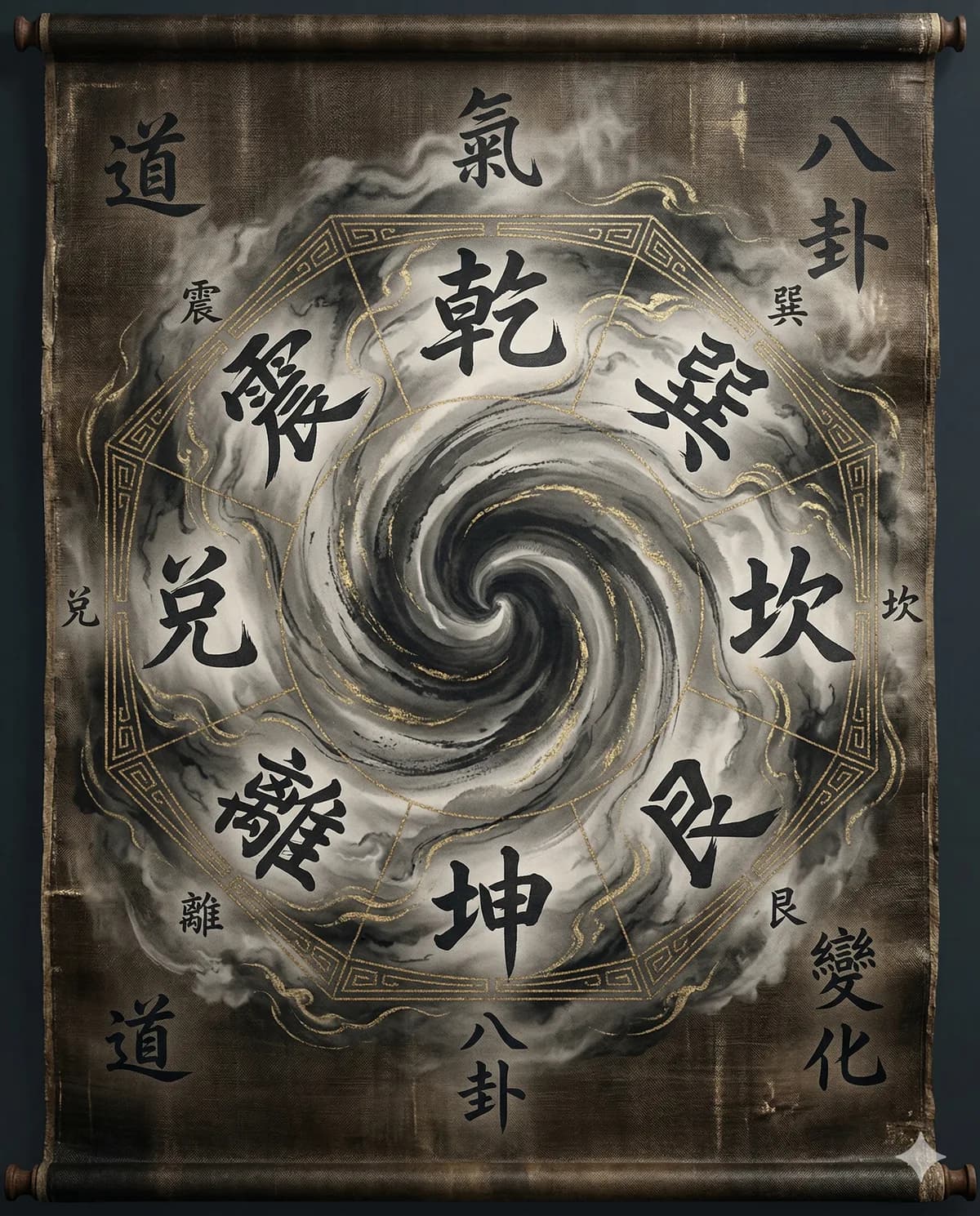
Ba Gua
八卦 · Bagua (Chinese characters)
RU: Ба Гуа
Ba Gua (Chinese 八卦, bāguà — "the eight trigrams") is a system of eight symbols, each composed of three lines (yao, 爻): solid (Yang, ⚊) and broken (Yin, ⚋).
The foundation of Chinese metaphysics. Ba Gua is the basis of the I Ching (易經, "Book of Changes", #6) and Feng Shui (#22). From the eight trigrams arise all 64 situations of the world.
The Eight Trigrams (Earlier Heaven Order of Fu Xi, 伏羲先天八卦)
- ☰ Qian (乾, qián) — Heaven, father, creativity, northwest
- ☷ Kun (坤, kūn) — Earth, mother, receptivity, southwest
- ☳ Zhen (震, zhèn) — Thunder, eldest son, arousing, east
- ☴ Xun (巽, xùn) — Wind, eldest daughter, penetration, southeast
- ☵ Kan (坎, kǎn) — Water, middle son, the abyss, north
- ☲ Li (離, lí) — Fire, middle daughter, clarity, south
- ☶ Gen (艮, gèn) — Mountain, youngest son, stillness, northeast
- ☱ Dui (兌, duì) — Lake, youngest daughter, joy, west
From Trigrams to Hexagrams
The 64 hexagrams. Combinations of two trigrams form 64 hexagrams (卦, guà) of the I Ching — a complete "alphabet of change" describing every possible situation in the world.
The Two Main Arrangements
- Earlier Heaven (先天, xiāntiān, Fu Xi) — the ideal cosmic order, the symmetry of opposites
- Later Heaven (後天, hòutiān, King Wen) — the manifest world, used in Feng Shui for spatial analysis
Translation note
Translate as 'ba gua' or 'eight trigrams'. Human Design (#13) uses 64 hexagrams as 'gates' with a different interpretive framework — not equivalent to traditional I Ching divination.
False friends / common mistakes
- ·
64 Gates in Human Design (#13) — structural use of hexagrams in different function
Term Info
Cluster Chinese
Script Chinese characters