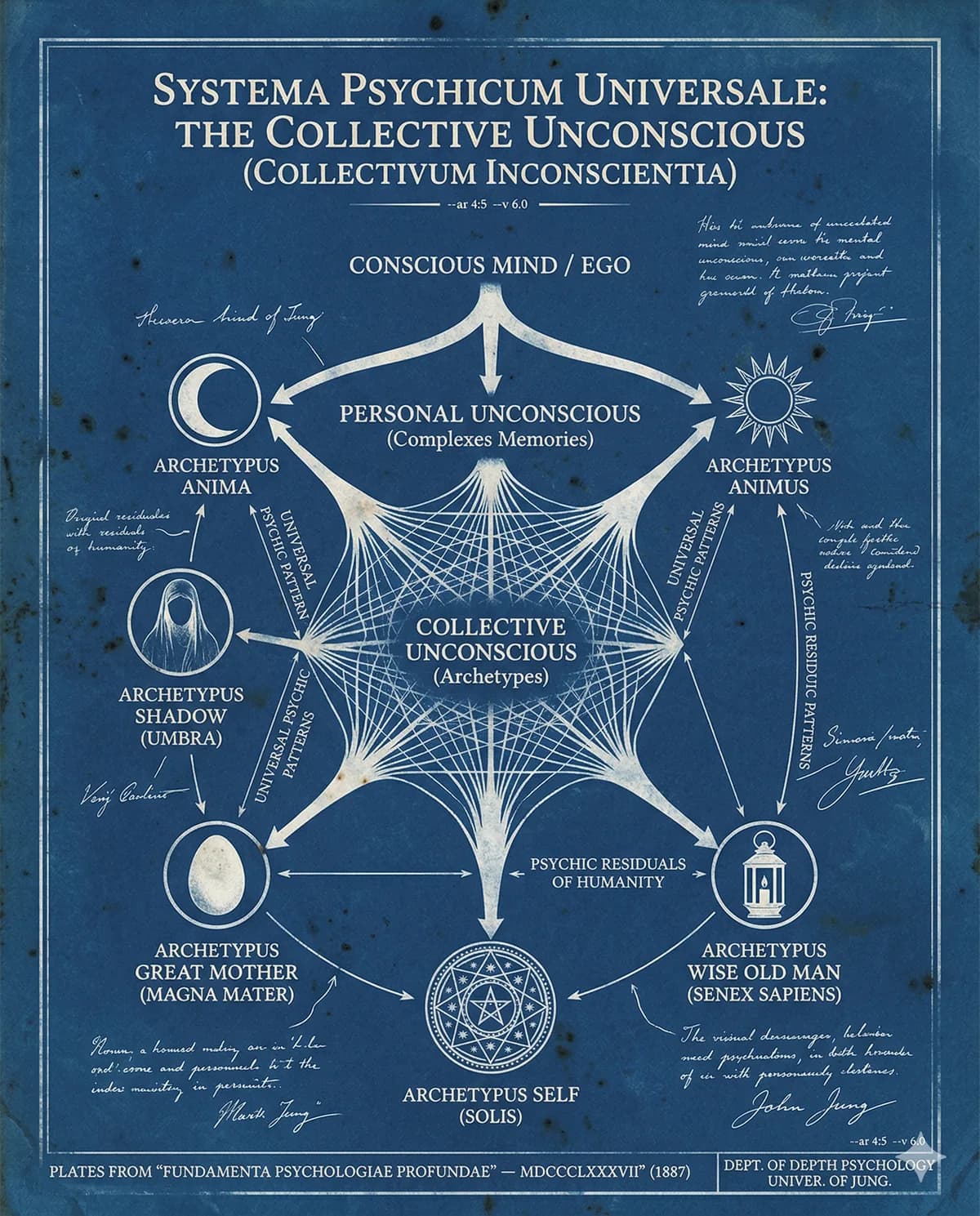
Collective Unconscious
Collective unconscious · Collective unconscious (Latin)
RU: Коллективное бессознательное
Collective Unconscious (German Kollektives Unbewusstes) is a concept of Carl Gustav Jung ("Über die Archetypen des kollektiven Unbewussten", 1934/1954): a deep layer of the psyche common to all people, containing archetypes — universal primordial images and patterns of behavior.
Three Levels of the Psyche (Jung)
- Consciousness (Bewusstsein) — "I", the ego, daytime awareness
- Personal unconscious (Persönliches Unbewusstes) — repressed memories, complexes
- The collective unconscious — the archetypal layer, independent of personal experience
Evidence of Existence (Jung)
Jung's empirical arguments. The existence of the collective unconscious is argued through three groups of observations:
- Recurring mythological motifs in cultures with no contact
- Typical images in dreams and psychoses
- Spontaneous reproduction of alchemical symbols by patients unfamiliar with alchemy
Significance for Errarium
The ontological basis of archetypal causality. In the Errarium context, the collective unconscious is the ontological basis of archetypal causality (axis C3): Tarot (#20), the runic oracle (#21), the monomyth (#45) all work through the activation of archetypal images.
Translation note
Translate as 'collective unconscious' (Jung's term). This is a psychological construct, not a metaphysical entity. Distinguish from shamanic spirit worlds (#28, #36): collective unconscious is intrapsychic.
False friends / common mistakes
- ·
Spirit world (Shamanism #28, #36) — autonomous reality of beings, not a psychic structure
- ·
Information field (#35) — holographic ontology, not a psychological construct
Term Info
Cluster Depth Psychology
Script Latin