
Classical Western Astrology
 Astrological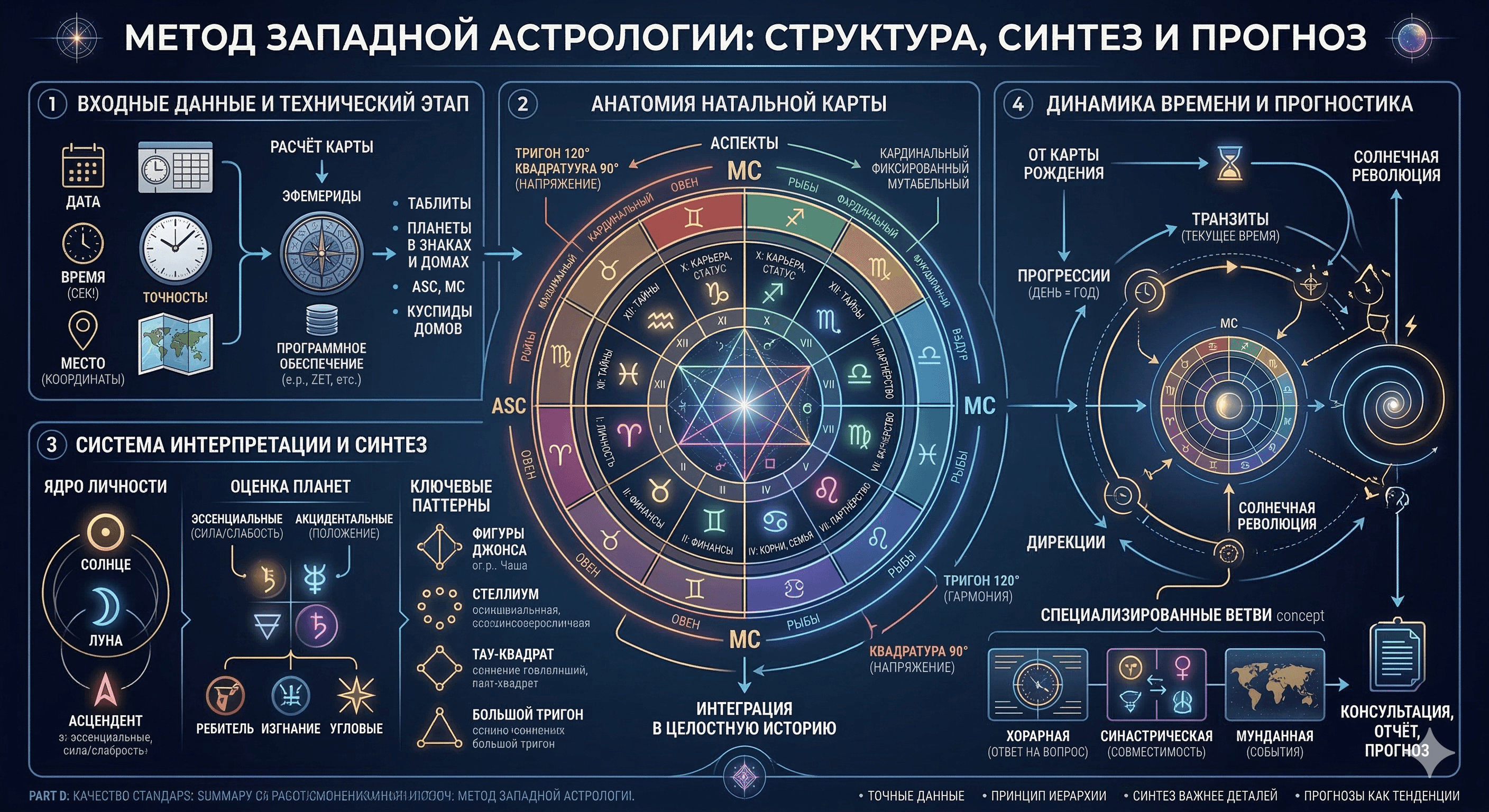
ON THE SPECIFICS OF THE METHOD
Western astrology is the most ancient system in the Atlas, whose continuous tradition can be traced from Babylonian astronomers through Hellenistic formalization to medieval Arab and European schools and onward to modern movements. The central object is the natal chart (horoscope): a projection of planetary positions onto the ecliptic at the moment of birth, tied to geographic coordinates. The method operates with a symbolic language in which celestial bodies, zodiac signs, houses, and aspects form a multilayered system of interpretation.
Parts A–C are written in the language of the astrological tradition (the practitioner's internal language). Parts D–G use neutral analytical language.
PART A: OPERATIONAL STRUCTURE
Input Data
Required:
- Date of birth — day, month, year (determines planetary positions in zodiac signs)
- Time of birth — accurate to the minute (determines the Ascendant and house system)
- Place of birth — geographic coordinates (determines house calculation and local projection)
Impact of data accuracy:
- Without an exact time of birth, it is impossible to determine the Ascendant and houses — the analysis is limited to a "solar" or "cosmogram" interpretation
- A 4-minute error shifts the Ascendant by approximately 1° — critical when a sign changes at the cusp
- Rectification — the procedure of refining the time of birth based on known life events
Calculation tools:
- Ephemerides (historical: Raphael, Michelsen; modern: Swiss Ephemeris)
- Errarium provides a built-in precise calculation: planetary positions, house cusps (Placidus), and lunar nodes are computed from date, time, and birthplace
- House tables (Placidus, Koch, Regiomontanus, Whole Sign, etc.)
Working Algorithm
Step 1. Chart erection Determining the positions of the Sun, Moon, planets (Mercury–Pluto), Lunar Nodes, Lilith, Chiron, and others in zodiac signs and houses at the moment of birth. Calculating the Ascendant (ASC), Midheaven (MC), and house cusps according to the chosen system.
Step 2. Determining aspects Calculating angular distances between planets. Major Ptolemaic aspects: conjunction (0°), sextile (60°), square (90°), trine (120°), opposition (180°). Additional: semi-sextile (30°), quincunx (150°), quintile (72°), etc. Each aspect has an orb (tolerance): typically ±6–10° for major aspects, ±1–3° for minor ones.
Step 3. Assessing planetary strength and condition
- Essential dignities: domicile, exaltation, triplicity, term, face — according to Ptolemy and Dorotheus
- Essential debilities: detriment, fall
- Accidental dignities: angular position (houses 1, 4, 7, 10), direct motion, speed
- Accidental debilities: cadent position (houses 3, 6, 9, 12), retrograde motion, combustion (proximity to the Sun)
Step 4. Analyzing chart structure
- Distribution of planets by elements (fire, earth, air, water) and modalities (cardinal, fixed, mutable)
- Jones patterns: bowl, bucket, locomotive, seesaw, splash, bundle, fan
- Stelliums (clusters of 3+ planets in a sign or house)
- House rulers: in which sign and house the ruler of each house is located
Step 5. Sequential interpretation
- Core of personality: Sun (essence), Moon (emotional nature), Ascendant (mask, first impression)
- Personal planets: Mercury (thinking, communication), Venus (values, relationships), Mars (action, will)
- Social planets: Jupiter (expansion, beliefs), Saturn (structure, limitations)
- Trans-Saturnian: Uranus (change, individuation), Neptune (ideals, illusions), Pluto (transformation, power)
Step 6. Synthesis Integration of all levels into a holistic description: not a collection of separate meanings, but a coherent narrative with priorities, tensions, and resources.
Step 7. Prognostic techniques (upon request)
- Transits: current planetary positions relative to the natal chart
- Progressions (secondary directions): one day of life = one year of life (day-for-a-year)
- Solar Return: chart for the moment of the Sun's exact return to its natal position
- Solar Arc Directions
Output Formats
- Natal chart (graphic): circular diagram with positions of planets, signs, houses, and aspects — the primary visual format
- Narrative analysis: text document from 5 to 50+ pages depending on depth
- Position table: planets in signs, houses, aspects — reference format
- Aspect grid: matrix of aspects between all planetary pairs
- Prognostic calendar: timeline of key transits and progressions for a given period
PART B: ANALYSIS VARIANTS
Minimal Analysis
Scope: Sun, Moon, Ascendant + 2–3 key aspects. What it provides: basic understanding of the personality "core" — conscious identity (Sun), emotional needs (Moon), manner of expression (ASC). What it excludes: houses, minor aspects, trans-Saturnian planets, prognostics. Application: popular astrology, initial orientation. Format: oral reading 30–60 minutes or short text (2–3 pages).
Standard Analysis
Scope: All 10 planets + Lunar Nodes, 12 houses, all major aspects. Content:
- Complete analysis of planetary positions in signs and houses
- House ruler analysis
- Aspect structure with highlighted dominants
- Elemental and modal balance
- Synthesis: key themes, resources, zones of tension
Format: written report (10–20 pages) + consultation 60–90 minutes.
Extended Analysis
In addition to the standard:
- Minor aspects and points (Chiron, Lilith, Vertex, Part of Fortune)
- Fixed stars at key points
- Progressions and directions: chart evolution over time
- Transit forecast for one year
- Solar Return for the current year
- Upon request: synastry (compatibility) or election (choosing a moment)
Format: 30–50 pages + a series of consultations.
Specialized Branches
1. Horary Astrology The chart is cast for the moment a question is asked (not the moment of birth). The answer is read from the arrangement of significators. Tradition: William Lilly (17th c.), Bonatti (13th c.). Rules are strict: there are criteria for chart "radicality" (suitability for judgment).
2. Mundane Astrology Charts of states, organizations, events. Ingresses (planetary entries into signs), eclipses, Jupiter–Saturn conjunctions. Applied to geopolitical and economic forecasting.
3. Electional Astrology Choosing the optimal moment to begin an action (marriage, founding a company, surgery). Criteria: favorable aspects, strong benefics (Jupiter, Venus), absence of afflictions to key significators.
4. Medical Astrology A tradition from Hippocrates and Galen: correspondence of zodiac signs to body parts, planets to organs and functions. In modern practice — a supplementary tool, not a replacement for medical diagnostics.
5. Synastric Astrology Overlaying two natal charts for compatibility analysis. Inter-aspect analysis + composite chart (Composite / Davison). Applied to romantic, business, and family relationships.
PART C: INTERPRETATION SYSTEM
Dictionary of Key Elements
| Element | Meaning in the System |
|---|---|
| Planet | Active force, principle, function of the psyche or destiny (Sun — will and identity, Moon — emotions and instincts, etc.) |
| Zodiac sign | Quality, style, modality of planetary expression (12 signs = 12 archetypal styles) |
| House | Life sphere, area of manifestation (12 houses = 12 spheres: from personality (I) to the collective unconscious (XII)) |
| Aspect | Type of interaction between planets: harmonious (trine, sextile), tense (square, opposition), neutral (conjunction) |
| Ascendant (ASC) | The sign rising in the east at the moment of birth. Determines the 1st house, the "mask," the way of interacting with the world |
| Midheaven (MC) | The highest point of the chart. Vocation, reputation, social standing |
| Ruler | The planet ruling a sign (Mars rules Aries, Venus rules Taurus, etc.). House ruler = the planet ruling the sign on the house cusp |
| Retrograde motion | Apparent backward movement of a planet. Traditionally: slowing, revision, internalization of the planet's function |
| Lunar Nodes | Points of intersection of the Moon's and Sun's orbits. South Node — "past experience," North Node — "direction of development" |
| Element | Fire (Aries, Leo, Sagittarius), Earth (Taurus, Virgo, Capricorn), Air (Gemini, Libra, Aquarius), Water (Cancer, Scorpio, Pisces) |
| Modality (Cross) | Cardinal (initiation), Fixed (stabilization), Mutable (adaptation) |
Logic and Rules of Interpretation
1. Hierarchy of significance. Sun, Moon, Ascendant — the main triad. The Ascendant ruler — the "lord of the chart." Planets on angles (houses 1, 10, 7, 4) have increased influence. Planets aspecting the Sun/Moon carry more weight than isolated ones.
2. Planet in sign + house = specificity. The sign determines "how," the house determines "where." Mars in Capricorn (disciplined action) in the 10th house (career) is a different configuration than Mars in Capricorn in the 4th house (family, roots).
3. Aspects modify. An unaspected planet acts without restraint. A planet in tense aspects is a source of growth through conflict. In harmonious aspects — natural talent, but a risk of passivity.
4. Rulers link houses. If the ruler of the 7th house (partnership) is in the 10th (career) — partnership and profession are connected. This "chain of rulers" creates invisible links between life spheres.
5. Synthesis is more important than details. Professional interpretation is not a listing of meanings, but the construction of a hierarchy: what in the chart is loudest, what supports, what contradicts. Recurring themes (one principle manifesting through different elements) = the key theme of the chart.
6. Context determines the level of manifestation. The same configuration manifests differently depending on culture, gender, age, and social environment. The chart shows a pattern, not a fate.
Typical Patterns
1. Grand Cross Four planets in squares and oppositions forming a cross. Powerful internal tension, a sense of being "trapped." High energy when the conflict is skillfully managed.
2. Grand Trine Three planets in trines (120°), usually in the same element. Natural talent, ease. Risk: passivity, complacency — energy flows without effort, no stimulus for development.
3. T-Square Two planets in opposition, a third in square to both. The focus of tension is on the "apex" planet. A driving force for achievement.
4. Stellium in one sign/house Concentration of 3–4+ planets. Hyper-emphasis on one theme: giftedness + obsession. Other life spheres may be "drained of energy."
5. Planet on the Ascendant A planet within 5–8° of the ASC colors the entire personality. Saturn on the ASC — seriousness, responsibility, a difficult start. Jupiter — optimism, prominence, expansion.
6. Sun–Moon Opposition (Full Moon in the natal chart) Tension between conscious will and emotional needs. Polarization: the necessity of integrating the "inner" and "outer" self.
7. Bucket with a singleton handle All planets in one hemisphere, one placed on the opposite side. The singleton is the focal point, the channel for realizing the energy of the entire chart.
PART D: QUALITY STANDARDS
Signs of Correct Application
- Precise astronomical data is used (ephemerides, not approximate positions)
- The house system is specified and the choice is justified
- Interpretation is built from general to specific: first the overall structure, then details
- Contradictory elements of the chart are not ignored but integrated ("yes, Sun in Aries gives drive, but Moon in Cancer needs safety — the person's task is to learn to combine both poles")
- The practitioner distinguishes between describing a pattern and prescribing an action
- Forecasts are formulated as tendencies and periods, not as specific events
Typical Practitioner Errors
-
"Cookbook astrology." Reading meanings item by item without synthesis: "Moon in Capricorn — reserved emotions. Mars in Aries — aggressiveness." Without connections between elements — this is not interpretation.
-
Ignoring the birth context. A chart of a person born in the 1950s and one born in the 2000s with identical positions will manifest differently due to culture, era, and gender.
-
Fatalism. "You have Saturn in the 7th house — you will never be happy in marriage." Substituting a tendency description with an outcome prediction.
-
Mixing house systems without understanding the differences. Placidus, Koch, Whole Sign — yield different planetary house placements; each system has its own justification.
-
Excessive detail. Accounting for dozens of asteroids, Arabic parts, and fixed stars without an overall picture. Particulars must not replace the whole.
Typical Interpretation Errors
-
Sun sign = entire personality. "You're a Scorpio — so you're jealous." The Sun sign is one element out of ~50 in a natal chart.
-
Linear reading of aspects. "Square = bad, trine = good." In reality: a square is a source of energy and growth; a trine is a resource that may remain unrealized.
-
Literal reading of houses. "Pluto in the 8th house = early death." This is a caricature of the tradition. Pluto in the 8th — intensity of transformations, themes of control and letting go.
-
Projection of personal experience. The astrologer "sees" in the client's chart their own themes. A professional is aware of the risk of projection.
Boundaries of Competence
- Is not medical diagnostics. Medical astrology is a historical tradition; today it does not replace a medical examination
- Is not psychotherapy. Describing a pattern is not the same as transforming it
- Does not predict specific events. "March will be a difficult period" — permissible; "in March you will lose your job" — not permissible
- Is not verifiable by scientific method in its current form: there are no reproducible experiments confirming a causal mechanism
- In cases of mental disorder symptoms — referral to a psychotherapist or psychiatrist
PART E: THEORETICAL BASE
Primary Sources
- Claudius Ptolemy. Tetrabiblos (Tetrabiblos, ~150 CE) — the fundamental treatise of Hellenistic astrology
- Vettius Valens. Anthology (~160 CE) — a practical guide to natal astrology
- Dorotheus of Sidon. Carmen Astrologicum (~75 CE) — electional and catarchic astrology
- Firmicus Maternus. Mathesis (~337 CE) — a late Roman compendium
- Guido Bonatti. Liber Astronomiae (~1277) — an encyclopedia of medieval astrology
- William Lilly. Christian Astrology (1647) — the principal text of the English horary tradition
- Alan Leo. Astrology for All (1910) — the founder of modern psychological astrology
Schools and Authorities
- Hellenistic school (Ptolemy, Valens, Dorotheus): the foundation of the system — signs, houses, aspects, dignities
- Medieval Arab school (Abu Ma'shar, al-Biruni, Masha'allah): Arabic parts, ingress techniques
- Classical English (Lilly): horary astrology, strict rules of judgment
- Theosophical / Psychological (Alan Leo, Dane Rudhyar): emphasis on spiritual development and psychology
- Humanistic (Dane Rudhyar, "The Astrology of Personality," 1936): astrology as a language of symbols, not prediction
- Evolutionary (Jeff Green, Steven Forrest): emphasis on the evolution of the soul, Pluto and Lunar Nodes
- Traditional revival (Robert Hand, Robert Zoller, Benjamin Dykes, Chris Brennan): return to Hellenistic and medieval techniques
Current State
- Major organizations: ISAR, NCGR, AFA (USA), Astrological Association of Great Britain
- Education: Kepler College (online), Robert Hand's school, STA (School of Traditional Astrology)
- Research: Correlation journal (scientific criticism), The Mountain Astrologer, The Astrological Journal
- Active trend: revival of Hellenistic astrology (Chris Brennan, The Astrology Podcast)
- Digitization: Astro.com (free calculations), Solar Fire, Time Passages — mass accessibility of calculations
- Scientific reception: studies by Shawn Carlson (1985, Nature), Dean & Kelly — do not confirm correlations; the astrological community criticizes experimental design
PART F: PRACTICAL FORMATS
Session / Consultation Formats
Individual natal consultation:
- Duration: 60–120 minutes
- Form: in-person or remote (Zoom, Skype)
- Preparation: client provides birth data; astrologer constructs and analyzes the chart before the session
- Structure: chart overview — key themes — client questions — prognostic section (if requested)
Prognostic consultation:
- Duration: 45–60 minutes
- Requirement: prior natal analysis must exist
- Content: transits, progressions, Solar Return for the coming year
Synastric consultation:
- Duration: 75–90 minutes
- Two natal charts + inter-aspect analysis + composite
- Applied to romantic, business, and family couples
Group format:
- Lecture / seminar on a specific topic (transits of the year, eclipses, Mercury retrograde)
- Master class on chart reading
Frequently Asked Questions
- What does my zodiac sign say about me?
- Are my partner and I compatible by horoscope?
- When will a favorable period come for [career / relocation / marriage]?
- What does Mercury retrograde mean?
- Why don't I resemble the description of my sign?
- Can what the chart shows be changed?
- What is my karma according to the Lunar Nodes?
- What will happen when Saturn returns to its natal position? (Saturn Return)
- How does Western astrology differ from Vedic astrology?
- How scientific is astrology?
Descriptive Fragment Examples
Fragment 1 — Solar-Lunar dynamics: "Sun in Aquarius in the 10th house points to a need for professional independence and a non-trivial contribution to society. Moon in Cancer in the 4th — alongside this, a deep attachment to roots, family, and a sense of home. The opposition between them (a Full Moon birth) is the central axis of the chart: a constant oscillation between the drive for innovation and the need for security. The task is not to choose one, but to build a rhythm in which both poles receive space."
Fragment 2 — Prognostic: "Transiting Saturn enters your 7th house in May and will remain there for about two and a half years. This is a period of partnership review: not 'destruction of relationships,' but a test of their solidity. Relationships with a real foundation will strengthen. Those held together by habit or fear of loneliness may require an honest conversation."
Fragment 3 — Aspect analysis: "The Mars–Saturn square in your chart is one of the most productive tense aspects. Mars wants to act immediately; Saturn demands a plan, discipline, long-term effort. The result: the first half of life — a feeling of being 'braked,' frustration. The second half — an outstanding ability for prolonged, methodical projects. This aspect is often found in the charts of athletes, military personnel, and builders."
PART G: PLATFORM COMPATIBILITY
Recommended Combinations
Jyotish (#18) Two astrological approaches to the same celestial data, but with different zodiacs (tropical vs. sidereal) and different techniques. Parallel application provides stereoscopic vision. Condition: do not mix — two separate analyses, one celestial vault.
Numerology (#5, #29, #30) Astrology works with spatial projection (the celestial sphere), numerology — with the numerical code of a name/date. Different input channels, sometimes overlapping themes. Useful for cross-checking emphases, but without mixing causal logics.
Jungian Archetypes (#11) Jung himself was actively interested in astrology. Archetypes (Anima, Animus, Shadow, Self) have astrological correlates (Moon, Sun, Pluto, MC). The combination provides psychological depth to symbolic reading.
Incompatible Combinations
- Big Five (#3) / MBTI (#4): Attempting to "confirm" a psychological test result with an astrological chart or vice versa — mixing statistical and symbolic causality
- Applied Kinesiology (#54): Bodily diagnostics and symbolic celestial analysis — different ontologies; combining them creates a false impression of mutual validation
What the Method Does Not Replace
- Psychotherapy: understanding a pattern is not the same as working through it
- Medical diagnostics: "medical astrology" is a historical tradition, not a replacement for examination
- Financial consulting: "financial astrology" is not an investment strategy
- Legal decisions: an astrological forecast is not a basis for legal actions
SOURCES
- Ptolemy. Tetrabiblos. Trans. F.E. Robbins. Cambridge: Harvard University Press (Loeb Classical Library), 1940.
- Valens, Vettius. Anthologies. Trans. Mark Riley. 2010 (available at csad.classics.ox.ac.uk).
- Lilly, William. Christian Astrology. London, 1647. Repr. Regulus Publishing, 1985.
- Rudhyar, Dane. The Astrology of Personality. New York: Lucis Publishing, 1936.
- Hand, Robert. Planets in Transit. Atglen, PA: Whitford Press, 1976.
- Arroyo, Stephen. Astrology, Psychology, and the Four Elements. Sebastopol: CRCS Publications, 1975.
- Brennan, Chris. Hellenistic Astrology: The Study of Fate and Fortune. Denver: Amor Fati Publications, 2017.
- Campion, Nicholas. A History of Western Astrology. 2 vols. London: Continuum, 2008–2009.
- Carlson, Shawn. "A Double-Blind Test of Astrology." Nature 318 (1985): 419–425.
- Holden, James Herschel. A History of Horoscopic Astrology. Tempe: AFA, 1996.
PART H: SOURCES AND BIBLIOGRAPHY
Canonical Texts of the Tradition
- Ptolemy. Tetrabiblos (Tetrabiblos, 2nd c. CE). — The foundational canon of Western astrology; systematization of planetary influences and aspects.
- Firmicus Maternus. Matheseos libri VIII (4th c. CE). — The most complete Latin astrological treatise of late Antiquity.
- Guido Bonatti. Liber Astronomiae (13th c.). — An encyclopedic compendium of medieval astrological practice.
- William Lilly. Christian Astrology (1647). — The fundamental textbook of horary and natal astrology.
- Alan Leo. Astrology for All (1910). — A key text of astrology's revival in the 20th century; introduction of Sun signs into mass culture.
Research and Critical Works
- Campion, Nicholas. A History of Western Astrology. Vol. 1–2. Continuum, 2008–2009. — An academic history of Western astrology from Mesopotamia to the present day.
- Tester, Jim. A History of Western Astrology. Boydell Press, 1987. — A classic study of the intellectual history of astrology.
- Curry, Patrick. Prophecy and Power: Astrology in Early Modern England. Polity Press, 1989. — A social history of astrology in 17th-century England.
- Bobrick, Benson. The Fated Sky: Astrology in History. Simon & Schuster, 2005. — An overview of astrology's role in world history.
Reference and Educational Publications
- Arroyo, Stephen. Astrology, Psychology, and the Four Elements. CRCS Publications, 1975. — The connection between astrology and depth psychology; the elemental approach.
- Greene, Liz. Saturn: A New Look at an Old Devil. Weiser Books, 1976. — Psychological interpretation of Saturn; the foundation of psychological astrology.
- Hand, Robert. Planets in Transit. Whitford Press, 1976. — A reference guide to transit interpretations; a standard practitioner's tool.
- Parker, Derek & Julia. Parkers' Astrology. Dorling Kindersley, 1991. — An encyclopedic introduction; visual format.
- March, Marion D. & McEvers, Joan. The Only Way to Learn Astrology. Vol. 1–6. ACS Publications, 1981–1994. — A complete course in Western astrology.
- Sasportas, Howard. The Twelve Houses. LSA / Flare, 1985. — A systematization of astrological house interpretation.
Deep Method Analysis #1 — Western Astrology (Classical) v1.0 — Errarium Project. Parts A–C — language of the astrological tradition. Parts D–G — neutral analytical language. The method describes symbolic patterns; it is not a scientific forecast and does not replace professional assistance in the areas of health, finance, or law.
Method Info
#1Classical Western Astrology
Data D1
Causality C2+C3
Time T0+T2+T3
Result F1, F2, F3, F4